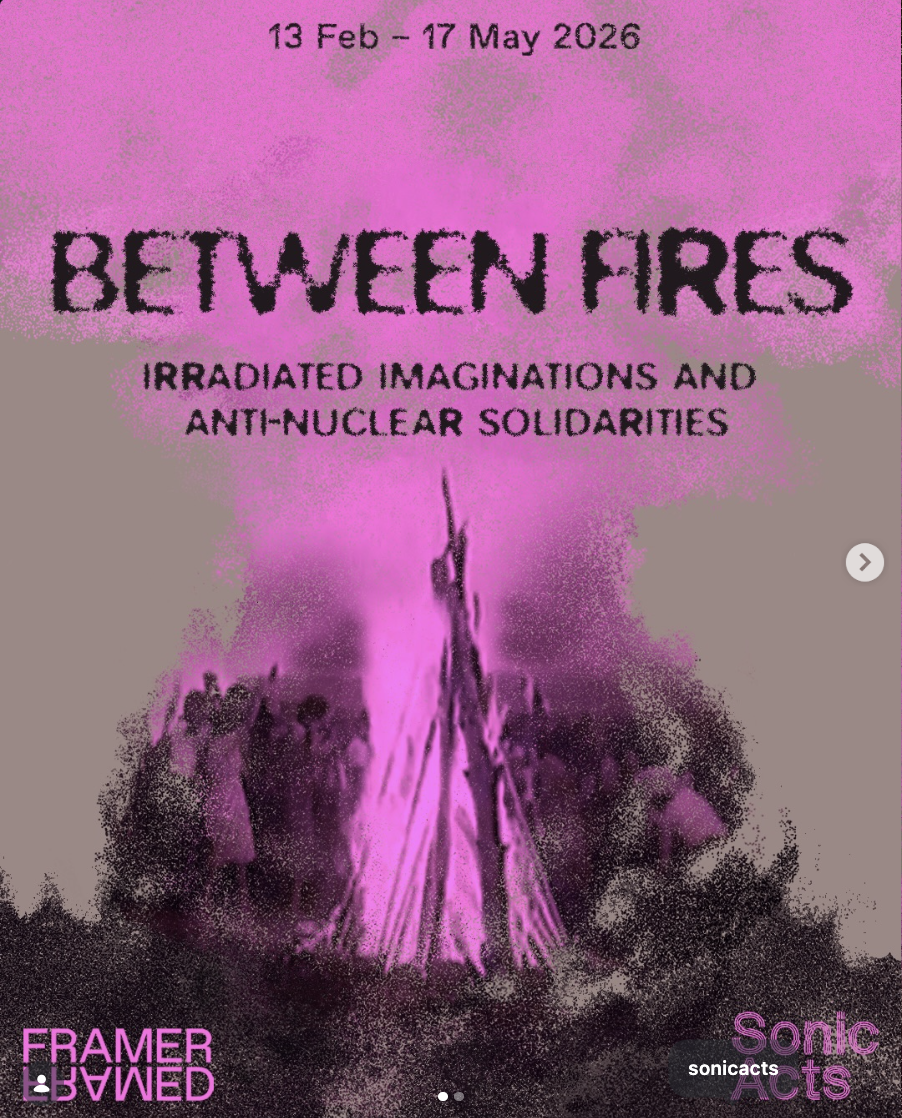
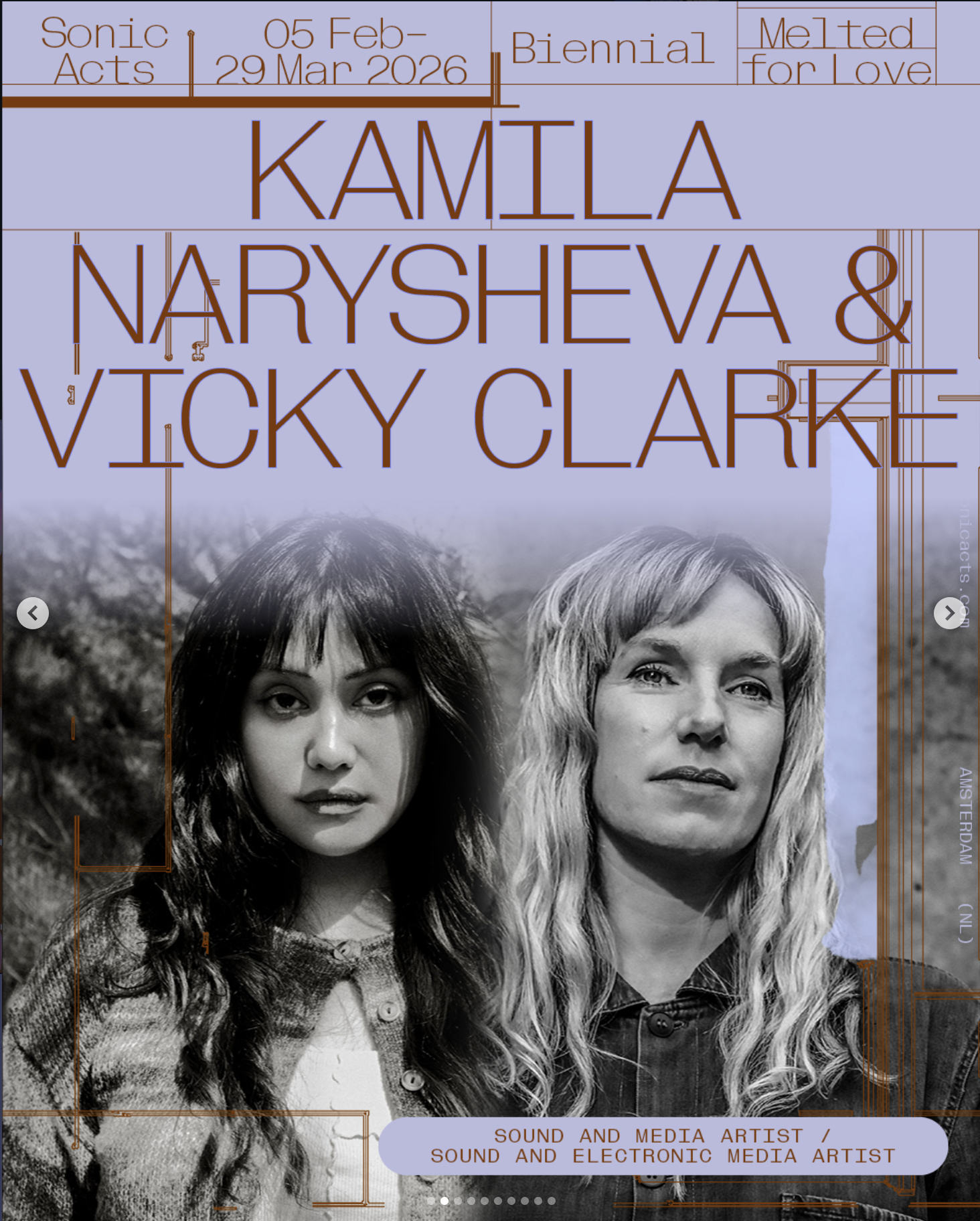
T1/2, our sound installation piece will feature within ‘𝐵𝑒𝑡𝑤𝑒𝑒𝑛 𝐹𝑖𝑟𝑒𝑠: 𝐼𝑟𝑟𝑎𝑑𝑖𝑎𝑡𝑒𝑑 𝐼𝑚𝑎𝑔𝑖𝑛𝑎𝑡𝑖𝑜𝑛𝑠 𝑎𝑛𝑑 𝐴𝑛𝑡𝑖-𝑁𝑢𝑐𝑙𝑒𝑎𝑟 𝑆𝑜𝑙𝑖𝑑𝑎𝑟𝑖𝑡𝑖𝑒𝑠’ exhibition at Framer Framed gallery in Amsterdam this spring, as part of the Sonic Acts Biennial 2026.
Curated by writer and researcher Fabienne Rachmadiev, the exhibition traces intertwined histories of nuclear infrastructures, colonialism and resistance, beginning in the Northern Kazakh steppe around Semey, where Soviet nuclear testing (1948-1991) caused lasting contamination of land, water and life. Behind the geopolitical, financial and militarised structures of the atom lie lifeworlds shaped by uranium mining, weapons testing and nuclear waste. Radiation’s invisibility – compounded by obscured nuclear infrastructures – produces a double erasure that complicates solidarity between affected communities.
The Nevada-Semey anti-nuclear movement countered this erasure by uniting communities in Kazakhstan and the US, contributing to the end of Soviet nuclear testing in 1989. In a powerful gesture, hundreds walked between two pillars of fire – an ancient purification ritual harnessed to repair radiation’s damage to the steppe.
The exhibition renews this transnational legacy through poetic, visual and sonic practices. Works by buulbuul, Demian DinéYazhi’, Inas Halabi, Äsel Kadyrkhanova, Dilyara Kaipova, Almagul Menlibayeva, Kamila Narysheva & Vicky Clarke, Roger Peet, and Emilija Škarnulytė, alongside research contributions by Kamila Smagulova and IISG, trace the spatial and temporal dimensions of nuclear colonialism across geographies.
LATENT SPACES_ STEP INSIDE A COMPUTER MODEL_INSTALLATION
A film by Pedro Küster
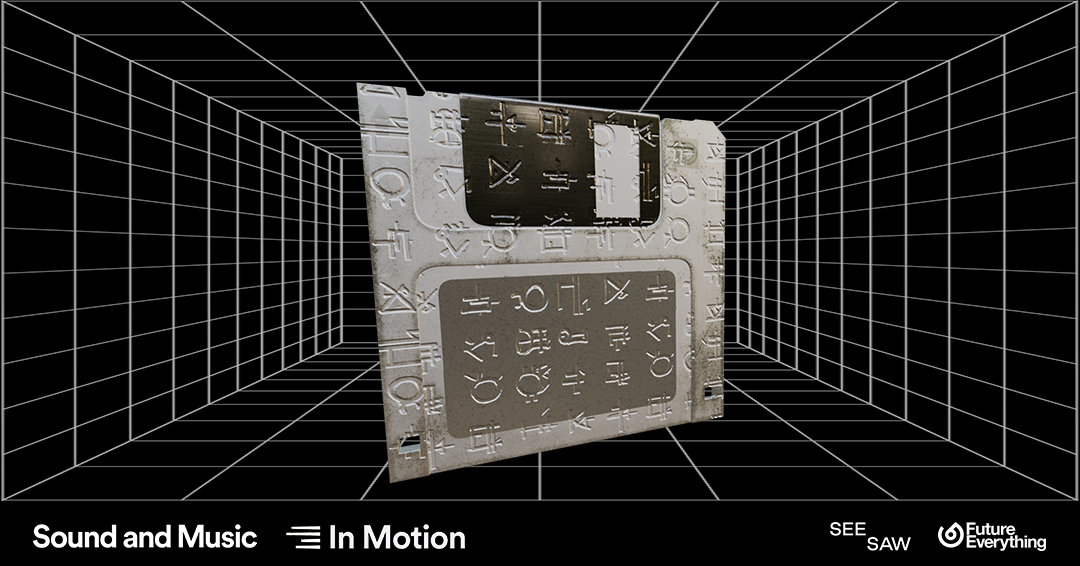
Latent Spaces is a spatial audio installation, exploring the hidden technological systems that surround us, and the materiality of sound within computational space. The work premiered at Seesaw Space, Manchester in October 2025, developed as part of the ‘In Motion’ Composer scheme with Sound and Music UK.
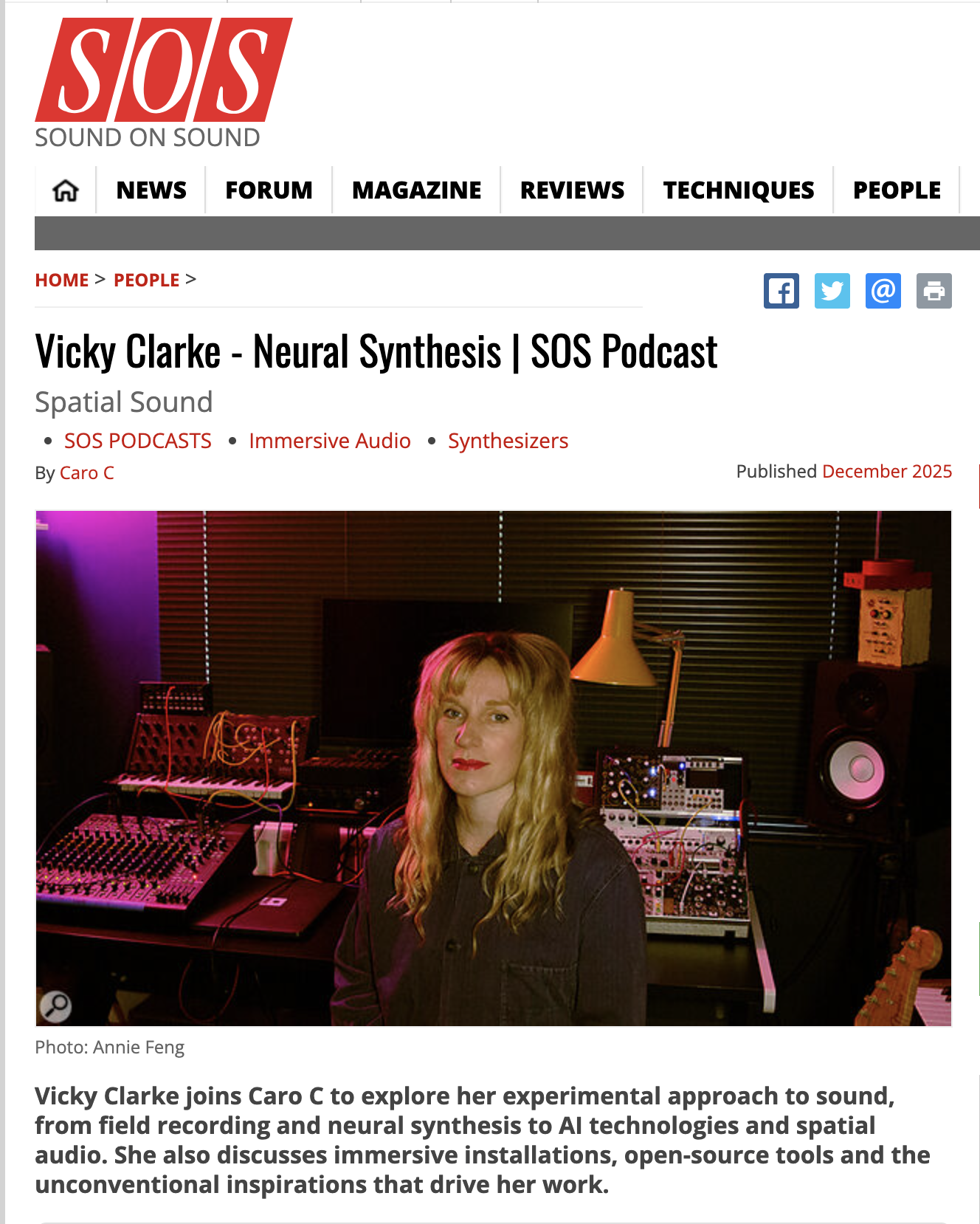
Last December 2025 I was interviewed for the Sound On Sound podcast. I had a wonderful chat with Caro C about my practice covering machine learning and musique concrete, DIY spatial audio and my electronics and composition practice.
T1/2 is a sound art project exploring the acoustic memory of the Semipalatinsk Test Site, Kazakstan. It is a collaboration with curator and artist Kamila Narysheva and myself, brought together through the British Council creative producers scheme. Also known as the Polygon, Semipalatinsk was the primary nuclear test site for the Soviet Union, subject to around 450 nuclear tests between 1949 and 1989. The project centres on how sound can capture and convey the intangible echoes of historical trauma both human and ecological. The work was presented as a sound installation at 101 Dump Gallery, Almaty in May 2025.
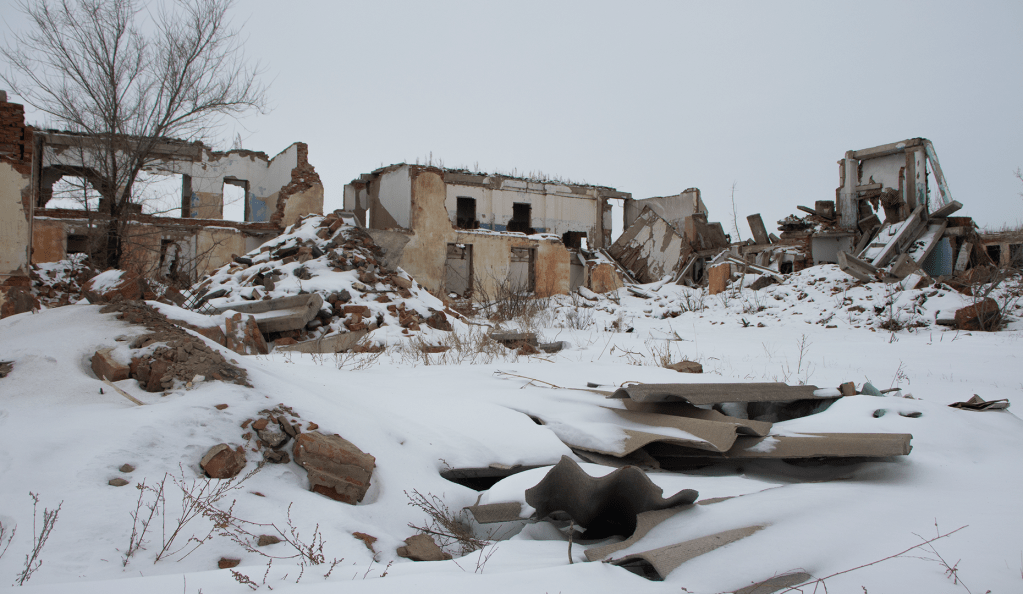
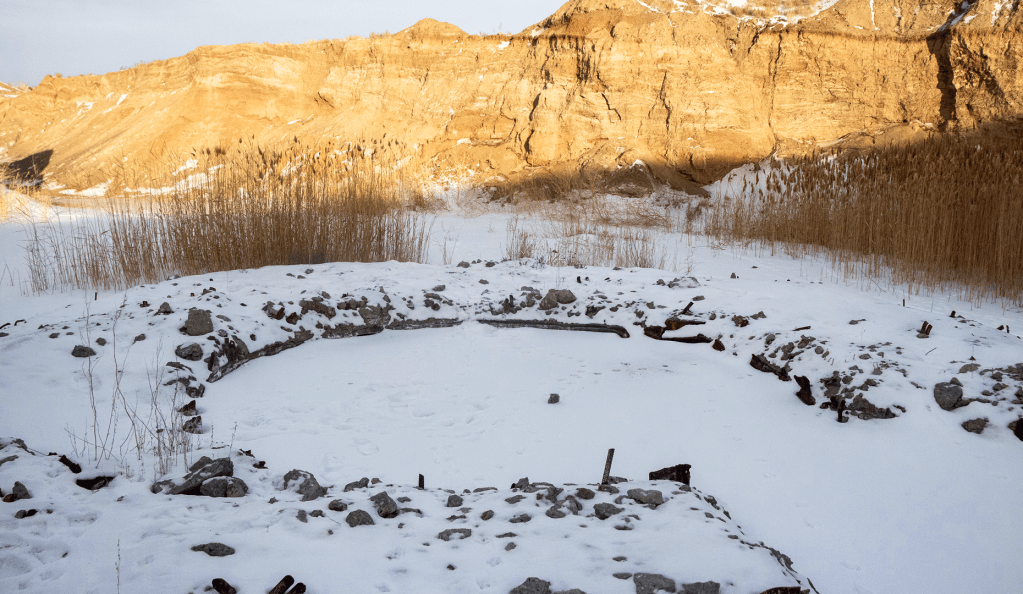
Collaborating online from Sept 2024 to May 2025, we developed our approach for the piece exploring the shared themes of deep time, technological materiality and transmutation. The process began with an expedition to the Semipalatinsk Test Site in December 2024, where Kamila captured field recordings of soil, water, air, and architectural remnants made using hydrophones, geophones, and contact microphones.
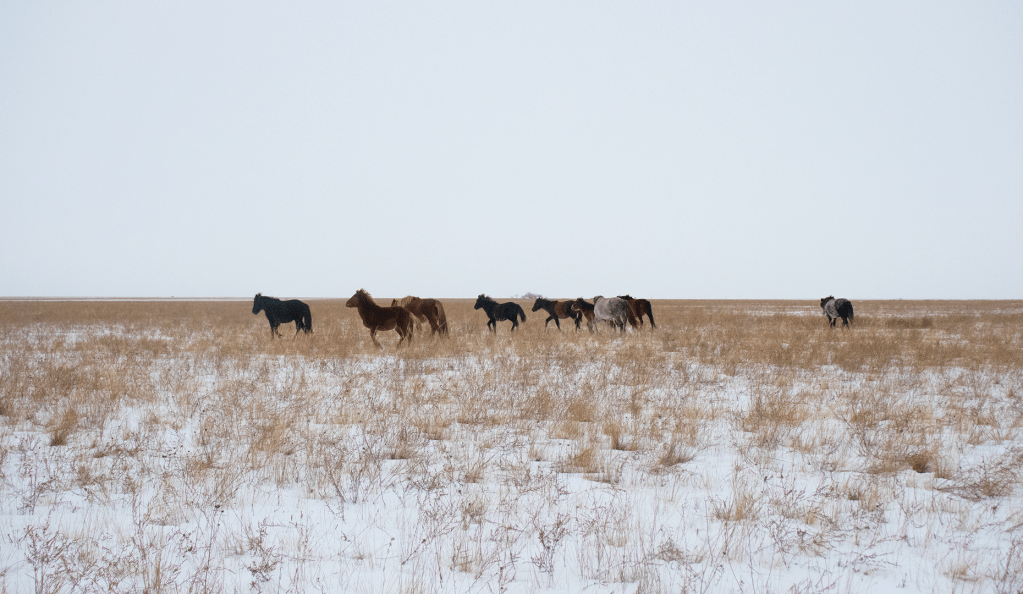
Captured at different levels of strata, key sites for recording included the atomic lake, the abandoned city of Shagan, subterranean bunkers and the environmental wind on the steppe. This created a vast corpus of sound material from which to work and form the narrative for the piece. The recordings included expansive environmental vistas of the sound such as the wind and animal sounds on the steppe – others were industrial, claustrophobic and tense. Despite the prevailing historical narratives of decay and destruction, the sound material offered hope and signs of nature regenerating itself. The personal connection of Kamila to the site (her father is from Semey) came through the material, with focused listening and engagement with the site through sound.
“And within that stillness, there’s a kind of quiet resilience. Grasses push through. Birds nest in old impact sites, horses graze along the road. The land hasn’t forgotten, but it’s learning to hold both damage and recovery at once.” Kamila Narysheva
PROCESS
We developed an T1/2 patch in MaxMSP to deconstruct the recorded material, algorithm that could decay sound material itself, so we developed a Half Life Max MSP patch that deconstructed recorded samples from the Polygon and used these within our piece. A key reference point was Togzhan Kassenova’s Atomic Steppe book, which lists the half lives of the radionuclides found on the Steppe, these include Carbon, Tritium, Strontium. From here we mapped and translated these (often very long) time intervals into more musical temporalities (i.e. number of seconds rather than years) that would take a sample at full fidelity and move to total degradation through an exponential curve.
THE INSTALLATION & PUBLIC PROGRAMME
T1/2 was premiered in the basement gallery of 101 Dump, a former Soviet building in Almaty earlier this year. A stereo set up with low blue light, providing a contemplative space for embodied listening. Alongside was a public programme that invited artists, researchers, and community members, especially those from Semey and nearby regions, to contribute. ASlong themes of nuclear legacy and justice
I was a selected artist on Immersive Assembly 4: Dreams and Echoes, a talent development programme exploring immersive arts and technology led by Mediale, in collaboration with the University of Oxford. The theme, ‘Dreams and Echoes’, invited us to “explore the potential of immersive media in interrogating consciousness and enabling new interpretations of reality.” On the programme we undertook tech workshops, conceptual dialogue and collaborated with neuroscientists to develop a prototype with another member of the artistic cohort to be presented at an industry event at the Cheng Kar Shun Digital Hub – Jesus College Oxford during the Oxford is Extraordinary season of Consciousness.
“Have you ever felt a dream slip into your day, like a shadow you just can’t shake?”
I collaborated with artist Michelle Collier on ‘To Lie Within Another’, an interactive installation exploring multi-layered consciousness, inspired by surrealist dream narratives, collage techniques and contemporary sleep science technological approaches.
APPROACH & TECHNOLOGY
We designed an interactive system using Touch Designer and Arduino, a gestural membrane interface, projection and layers of permeable gauze. The audience member pushed through a physical textile veil to reveal other layers of perception. These layers were animated digital photographic collages that appeared on screen, each layer morphing and blending the given fragmented state or reality. This computer system reflected the fragmented, transitory and fleeting and juxtaposed neurological patterns of association.
Michelle and I adopted surrealist techniques approached in our work (this was 2024, 100 years of Surrealism), keeping dream diaries and conducting sharing sessions in our own dream labs. These conversations informed our visual layers for the piece exploring memory, grief and our relationship to technology – as a mediating layer.
For our research was shaped by conversations with professors of Neuroscience Vladyslav Vyazovskiy and Russell Foster, exploring states of consciousness, notions of time and sensory physicality within dreaming.
PROTOTYPE
This was a stage one prototype, proof of concept. We envisage this piece on a larger scale working with more layers, sensory inputs and complex computational system.
IA4 is supported by the Cultural Programme at The Schwarzman Centre, University of Oxford, the Cheng Kar Shun Digital Hub at Jesus College Oxford, and Mediale’s talent development focus supported by Arts Council National Portfolio Organisation funding.
Exhibition Open: Friday 24th (10-5pm) & Saturday 25th & Sunday 26th (11-3.30pm) – No tickets required, showings run every half hour.
ABOUT THE EXHIBITION
We’re surrounded by invisible technological systems where machine learning and covert algorithms shape our everyday lives.
These systems can feel abstract and mythical in their invisible influence. But they impact our world in very real ways.
At the heart of these systems is latent space, a data dimension in a state of flux, where material becomes data, past meets future, and new machine languages emerge.
How do we imagine these spaces? What if you could step inside an environment like this? What do they sound like? And what might they evoke in you?
Latent Spaces is a sound installation that invites the audience to step inside the Aura Machine – an imaginary computational model combining spatial audio, sculpture and digital objects.
Once inside the machine’s latent space, the audience can experience a materiality in flow, where sonic echoes of past technological eras emerge, morph and fall apart.
Occupying a heritage textile building, the work layers a virtual, imaginary space over a real, physical space of industry. In doing so, it makes a connection between computational and industrial spaces as sites of constant flux. Both are places where meanings ‘become’, histories change and material holds memory.
WHAT TO EXPECT FROM THE EXPERIENCE
Inside the Aura Machine, an industrial soundscape unfolds: Manchester millscapes meet rhythmic cotton machinery from Quarry Bank Mill, and the material sounds of electricity, glass and metal. These sounds – field recordings captured by the artist – make up the machine’s dataset, used to train an early lo-fi neural synthesis model called PRiSM SampleRNN, now itself a historical relic.
Audiences will be immersed in the emerging machine language through a sonic composition of mill sounds and industrial history, and visual symbols (the Aura Machine icons) in the form of metal sculpture, cotton drapes and moving images.
WHY NOW?
We’re living in the era of latent space, a time when invisible systems are remaking our world, changing our society and impacting the climate. As new technologies emerge at speed, we must invent symbols and evolve language to make sense of these systems to understand their potential.
Can we create our own myths and forge an alternative language? Latent Spaces sites our position in the current AI hype cycle, within a technological history of invention. Can we reclaim control and creatively reimagine these spaces more ethically and ecologically as slow, local and DIY?
ABOUT THE ARTIST
Vicky Clarke (aka SONAMB) is a sound and electronic media artist from Manchester, UK, whose work explores materiality, electrical phenomena and ritual. Latent Spaces is her first solo installation, and marks the third in a series of works exploring machine learning and musique concréte, Clarke’s research in this area began in 2019. through a British Council research trip to Russia and an artistic residency with NOVARS, University of Manchester in collaboration with PRiSM, Royal Northern College of Music. Here she developed methods of building custom datasets of her own recordings and explored what happens to the materiality of sound in neural networks to create ‘AURA MACHINE’, her live AV piece was recently released on LOL Editions label. This was followed by ‘NEURAL MATERIALS’, a Cyborg Soloist commission, from University of Holloway and UKRI, to develop a performance system for AI, sculpture and electronics. Latent Spaces draws on post industrial sounds from these projects including cotton mill machinery from Quarry Bank Mill where her father trained as an apprentice electrical engineer.
During her research, Clarke became interested in latent space, with its unknowable qualities and language of ‘hidden layers.’ Drawn to the idea of ‘statistical alchemy’, she was fascinated by the sound world of neural synthesis, and the visual representations of latent space in Machine Learning text books. She began to imagine what it might be like to step inside.
Notes on Technology Use
Clarke’s practice engages critically with emergent technologies, opening up systems through education and access, with an approach grounded in the lo-fi and DIY. Use of technology in the piece:
On Authorship – All content is original material created by the artist, no dataset scraping
On Training – Training took place locally (RNCM) in collaboration with Dr Christopher Melen
Open Source Models – The machine learning models used in the piece are
StyleGAN(2019) for visuals: trained locally on a custom Techno-Symbolic dataset
SampleRNN(2020) for sound: trained locally on a custom Post-Industrial dataset
SUPPORTERS
This work was made possible by Sound and Music’s In Motion programme. In Motion 2024 is supported by Arts Council England, Jerwood Foundation, Garrick Club Charitable Trust, PRS Foundation & Marchus Trust.
Sound and Music is a PRS Foundation Talent Development Network Partner supported by PPL UK.
With exhibition support from FutureEverything, as part of the Innovate UK-funded Cultural Accelerator programme.
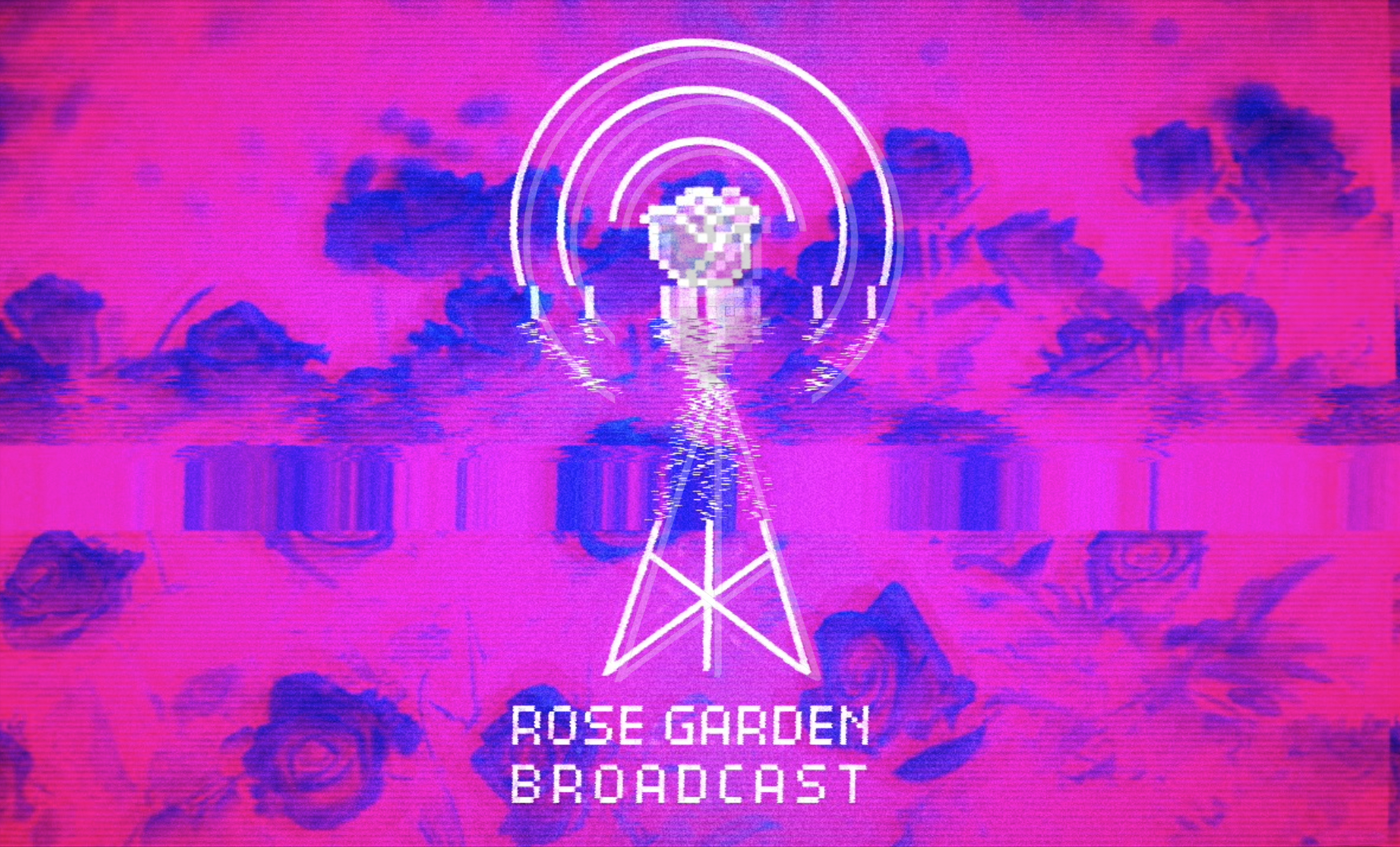
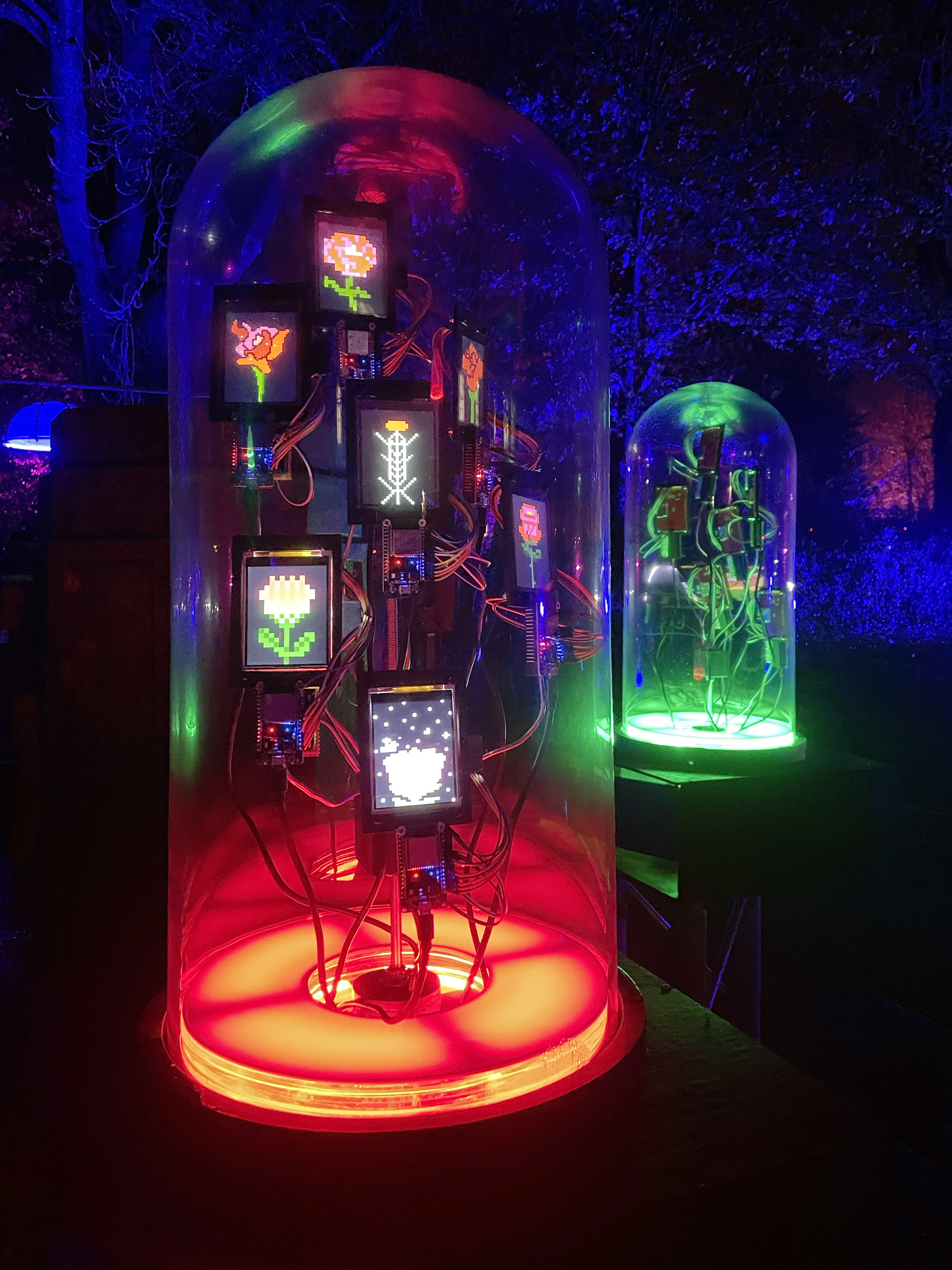
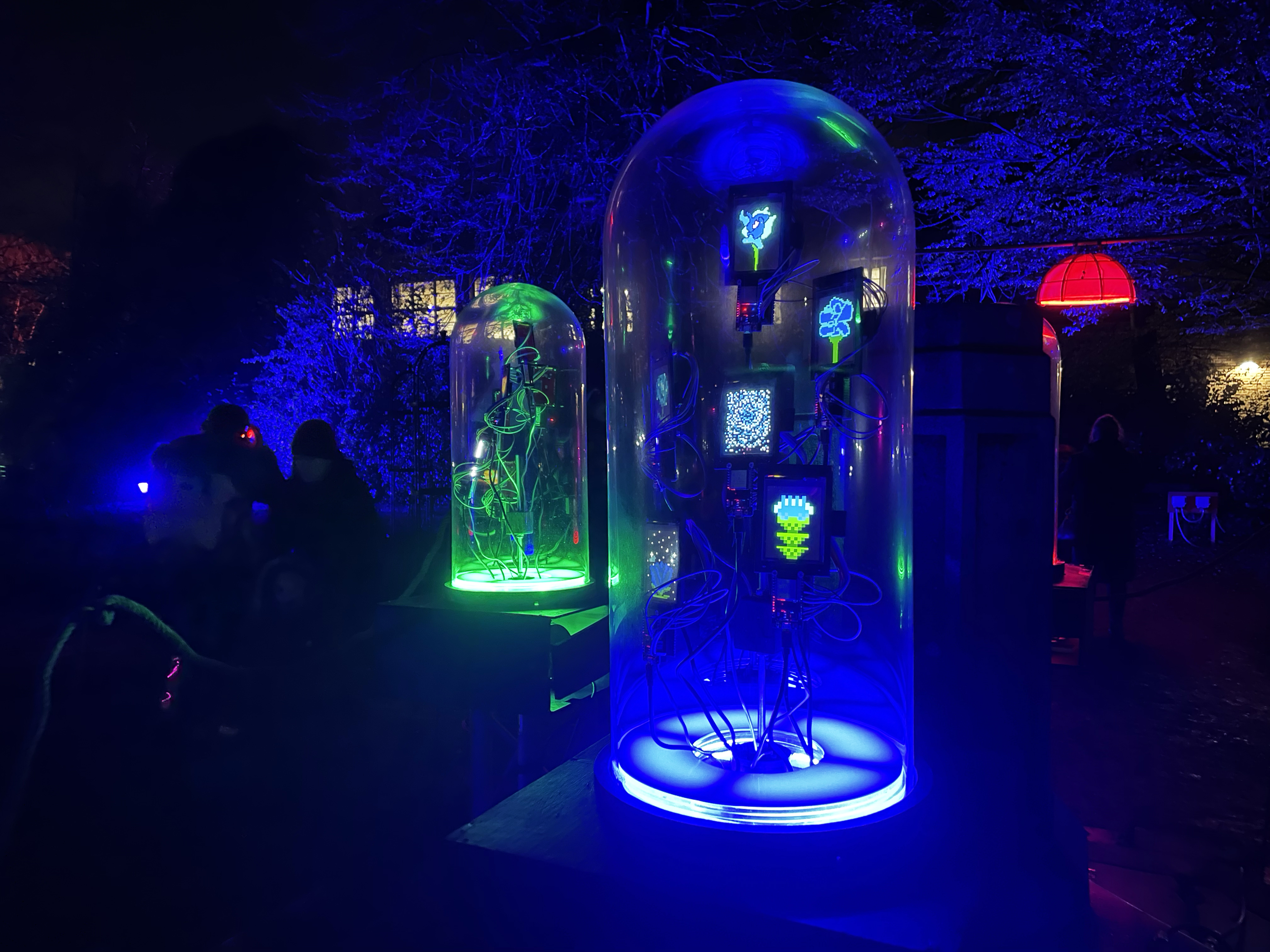
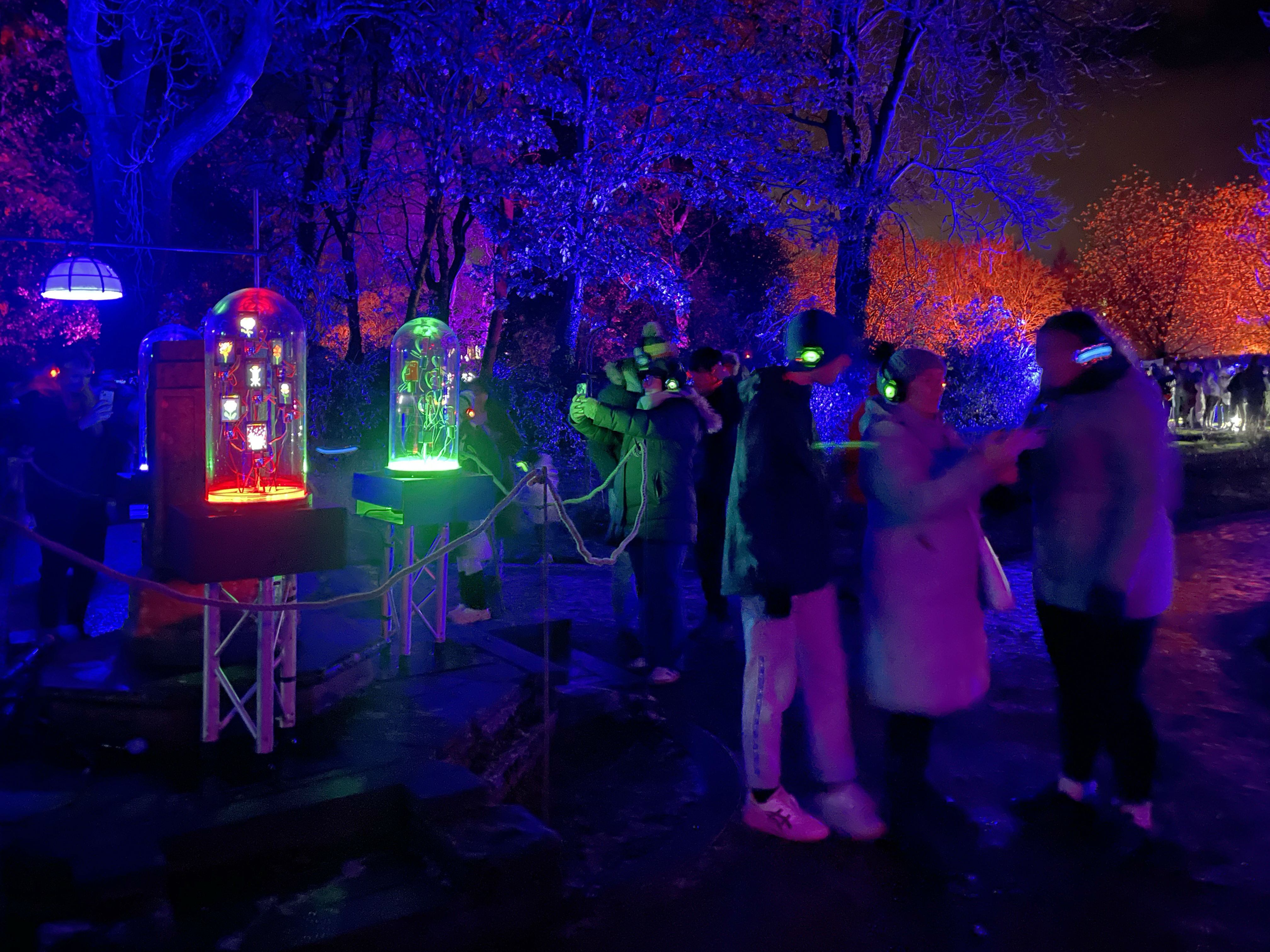
Rose Garden Broadcast amplifies and transmits the hidden elemental sounds below and above the surface of the Rose Garden and the surrounding environment of Mesnes Park Wigan. It is a new collaboration by artists Vicky Clarke and Kathy Hinde for Light Night Wigan 2024, commissioned by Things That Go On Things co-created with young people from Wigan.
Rose Garden Broadcast invites audiences to wear wireless headphones and tune in to three different ‘earth to sky’ frequency bands broadcast from electronic, illuminated radio sculptures housed in Victorian glass cloches. Though dormant in winter, Rose Garden Broadcast will ‘bring back the blooms’ as digital twins. The cloches will house LED screens displaying pixel art roses, digital doppelgangers of the rose species as created by local young people from Wigan.
LATENT SPACES is a work in progress for 2025 | Comprising an EP release in April, and a spatial sound installation in October.
LATENT SPACES explores our perceptions of sonic, computational and cerebral spaces, considering what happens to the materiality of sound in the latent space of a neural network model. In these hidden spaces where statistics meets alchemy, and sound becomes data, we imagine different symbolic realms of utopia, fear and technological myth. LATENT SPACES invites the listener to enter a computational model and experience a materiality in flux.
Combining machine learning and musique concréte, sound sculpture and electronics, the project begins with the AURA MACHINE EP on LOL Editions release in April, and ends with the LATENT SPACES spatial sound installation in October 2025.
The work is created using custom concrète datasets of post-industrial field recordings, comprising echoes of industrial millscapes and material eras of electricity, glass and metal, trained on PRiSM SampleRNN neural synthesis model. It builds on her artistic research since 2019 into machine learning & musique concréte as resident artist with NOVARS, University of Manchester in collaboration with PRiSM, Royal Northern College of Music, and ‘Neural Materials’, a Cyborg Soloists commission.
Latent: a state present but not yet manifest; hidden but not apparent.
LATENT SPACES is created by sound artist Vicky Clarke aka SONAMB. This work is made possible by Sound and Music’s In Motion programme. In Motion is supported by Arts Coun- cil England, Jerwood Foundation and Garrick Club Charitable Trust. With exhibition support from FutureEverything, as part of the Innovate UK-funded Cultural Accelerator programme Keep up to date:
From Sept 2024 – Feb 2025, I have been one of the R&D artists selected for the Cultural Accelerator programme, a new collaborative project between Future Everything, MediaCity Immersive Technologies Innovation Hub (MITIH) and Dream Lab, University of Salford to support artists developing work in immersive technologies.
‘Enter Latent Space’ is a WIP audio visual project inviting audiences to step inside and experience a computational ‘latent’ space, opening up the ‘black box of AI’. This artwork will manifest as
[V2] a virtual prototype built in a games engine and experienced via a VR headset
[V1] a physical spatial sound installation, incorporating sound sculpture, neural synthesis, electronics and 6:1 speaker array
On the programme I have been working on the [V2], learning skills working in Unity games engine to translate my 3d sculptures and build a 360 computational environment. I am experimenting with using Unity as a prototyping environment for a physical spatial sound installation. The idea being to create a 3d visual world to experiment with audience navigation and experience digitally, and test different aesthetics in preparation for the real world installation. Both prototypes will be shared publicly in October 2025 in an exhibition at Seesaw space.
I am thrilled to announce my selection for IN MOTION, the composer scheme from Sound and Music UK 2024-2025. This is a huge honour for me, and I am truly humbled to have been granted this opportunity among some inspirational composers. The programme will enable me to take a step back and think about my music making, and crucially develop my compositional skills and understanding of mixing and mastering in pro studio settings. There will be chance to work alongside music mentors and coaches to gain industry and personal knowledge – I can’t wait! Practically it will allow me some R&D time to think about how to translate the work I have been making in Sonic AI for the last few years into a new sound installation context. I look forward to learning new skills for spatial composition and reconsidering my work in this way, connecting with new partners and artistic collaborators – bring it on. Personally I love that this programme is about music and thats it, music is my life and the chance to really go within and focus on what this means is a true blessing. Thank you thank you, Love V x











 VICKY CLARKE