TESTCARD_Summer Stream

AUGUST 2020

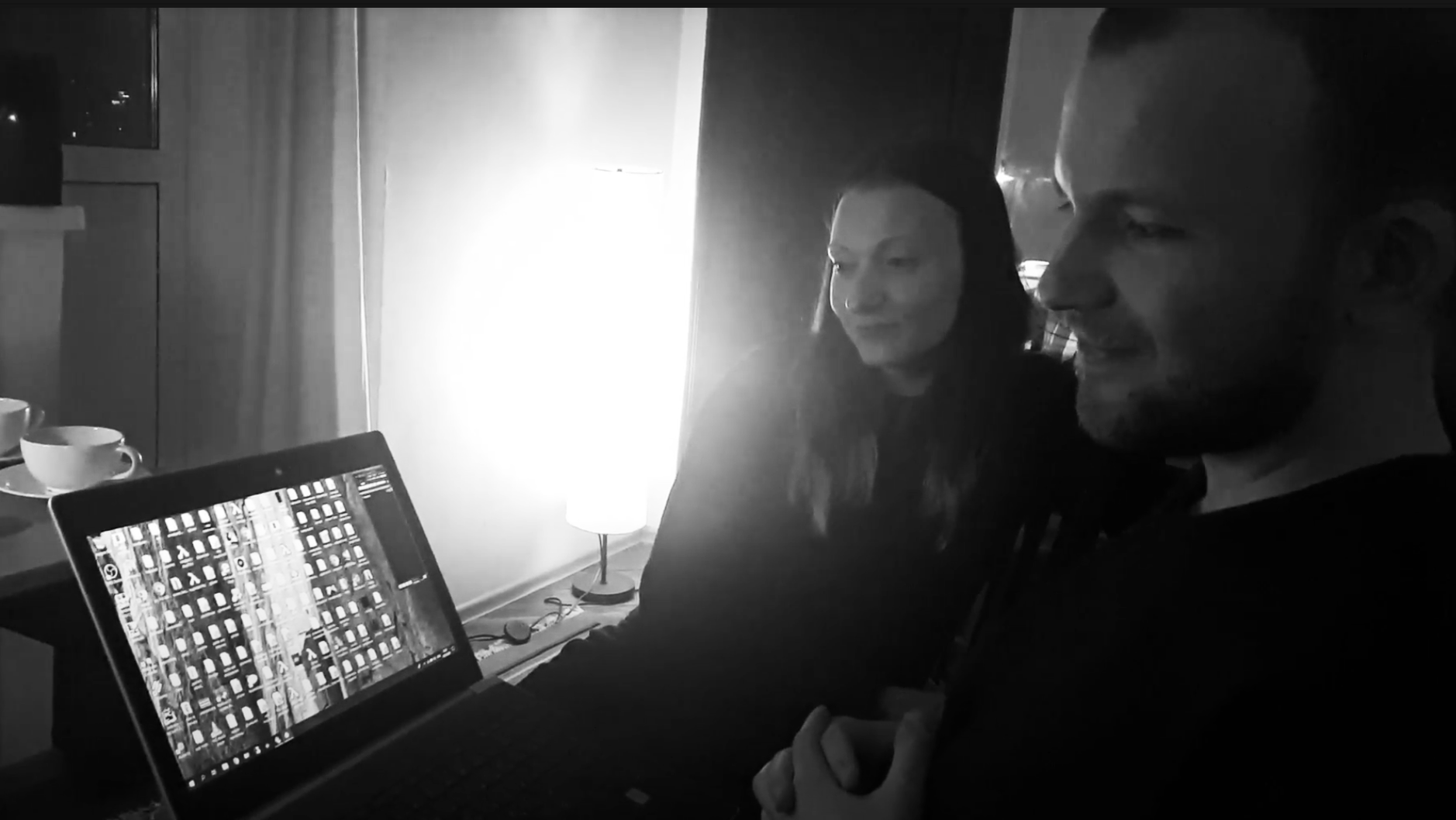
First gig since lockdown with my favourite music people at Manchester’s TESTCARD, I collaborated with digital artist Izzy Bolt on our first live performance together at Niamos in Hulme. Also on the socially distanced bill was the fantastic Danny Ruane, with amazing visuals and live stream controlled by Sean Clarke, CHEX and Dede. It felt great to be in a venue again, enjoying the ritual of setting equipment up and down and playing through a system. Was great to finally work with Izzy as we’d been talking about collaborating for what seems like ages, more to come i’m sure. Thanks to Johnny James and Creative Tourist for the event write up too!

HfG: Critical AI Studies

During lockdown i’ve been studying with the University of Karlsruhe, undertaking the ‘Introduction to AI and Neural Networks’ course. The module is part of the media art and philosophy department at HfG with the research group KIM: Critical Artificial Intelligence. Led by Professor Matteo Pasquinelli, the course was hosted online and welcomed students from across the globe studying media art, data science and many other humanities and science subjects.

The course was a theoretical and art historical introduction to artificial intelligence charting the the AI winters and summers of scientific discovery, investigation and academic and industrial funding. I was fascinated by the technical development timeline and trajectory of the AI from the Perceptron to the Deep learning revolution.

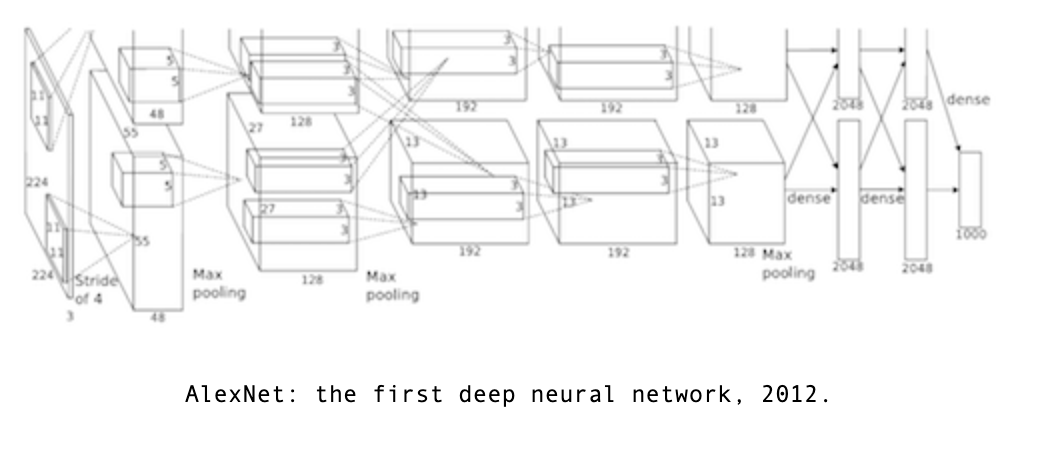
Practically we learned about the constituent parts of a neural network from training data, model and algorithm to try to establish a mental architecture of these statistical systems. In this crazy year of 2020 the explosion of facial recognition deployment in many sectors and increased dynamics of human quantification and the entanglement of big tech, corporate and academic sectors this course was politically pertinent for the current climate.

Crucially as a media art course, we studied the ethical implications of training datasets, the power dynamics, biases and issues of ownership and authorship inherent with these systems from how they are created, who by and the purposes they serve explicitly and privately.

My tutor Matteo Pasquinelli was an excellent and enigmatic teacher, the start of the course coincided with his releasing a new work ‘The Nooscope Manifested: AI as Instrument of Knowledge Extractivism’ a collaboration with Vladan Joler, an essay and cartographic map aimed to demystify the processes within AI from human and technical perspective. Viewable here

I recommend exploring the KIM research group website, so many interesting papers and research angles in this area.

FACTmag ARTIST DIY

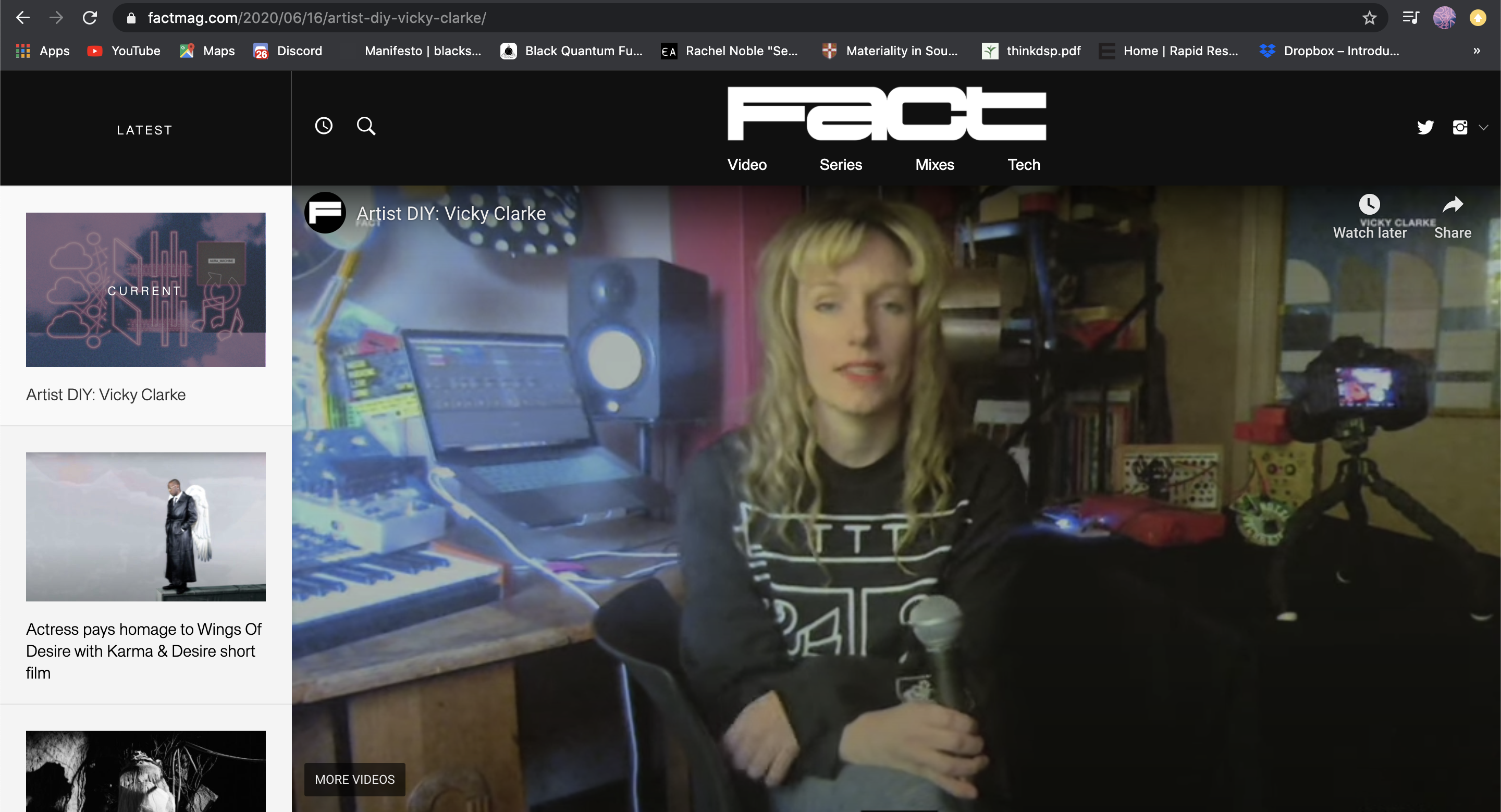
Deep into lockdown in May 2020, I was asked by FACTmag to make a video about my practice. Part of ArtistDIY, a series of videos made by artists in collaboration with FACT in response to the COVID-19 pandemic. FACT edits each episode remotely, while the artist shoots at their home or studio with whatever equipment they have available.

In full DIY mode I set up my home studio with cameras and mics (and lots of takes), it was actually therapeutic for me to concentrate on this project during such a turbulent time, it was a joyful experience and I was really supported by the team at FACT especially super talented film maker Pedro Kuster. I was overwhelmed by the online response from people, it really provided a confidence boost during an especially difficult time and spurred me on to keep making music. Thank you FACT x

Read the full feature here: https://www.factmag.com/2020/06/16/artist-diy-vicky-clarke/

UK-RUSSIA YEAR OF MUSIC

MACHINE LEARNING AND MUSIC AURAMACHINE RESEARCH TRIP

BRITISH COUNCIL | FEBRUARY 2020

As part of British Council’s UK-RUSSIA year of music programme I travelled to Russia to undertake creative research for AURA MACHINE, my (then) speculative project idea, a proposed artwork in the early stages of development to create a sound sculptural machine that uses machine learning algorithms to generate new audio output based on a data set of material concrete sounds. I wanted to explore the potential of live inputs with neural networks to realise future materialities. Supported by my UK partner FutureEverything and RU partner Ilia Symphocat, the main aims of my trip were to

  • Connect with artists using machine learning in their artistic practice
  • Collaborate and perform with my host part Ilia Symphocat
  • Sound Sculpture and machine design – explore visual aesthetics through visiting collections of technical and sonic objects
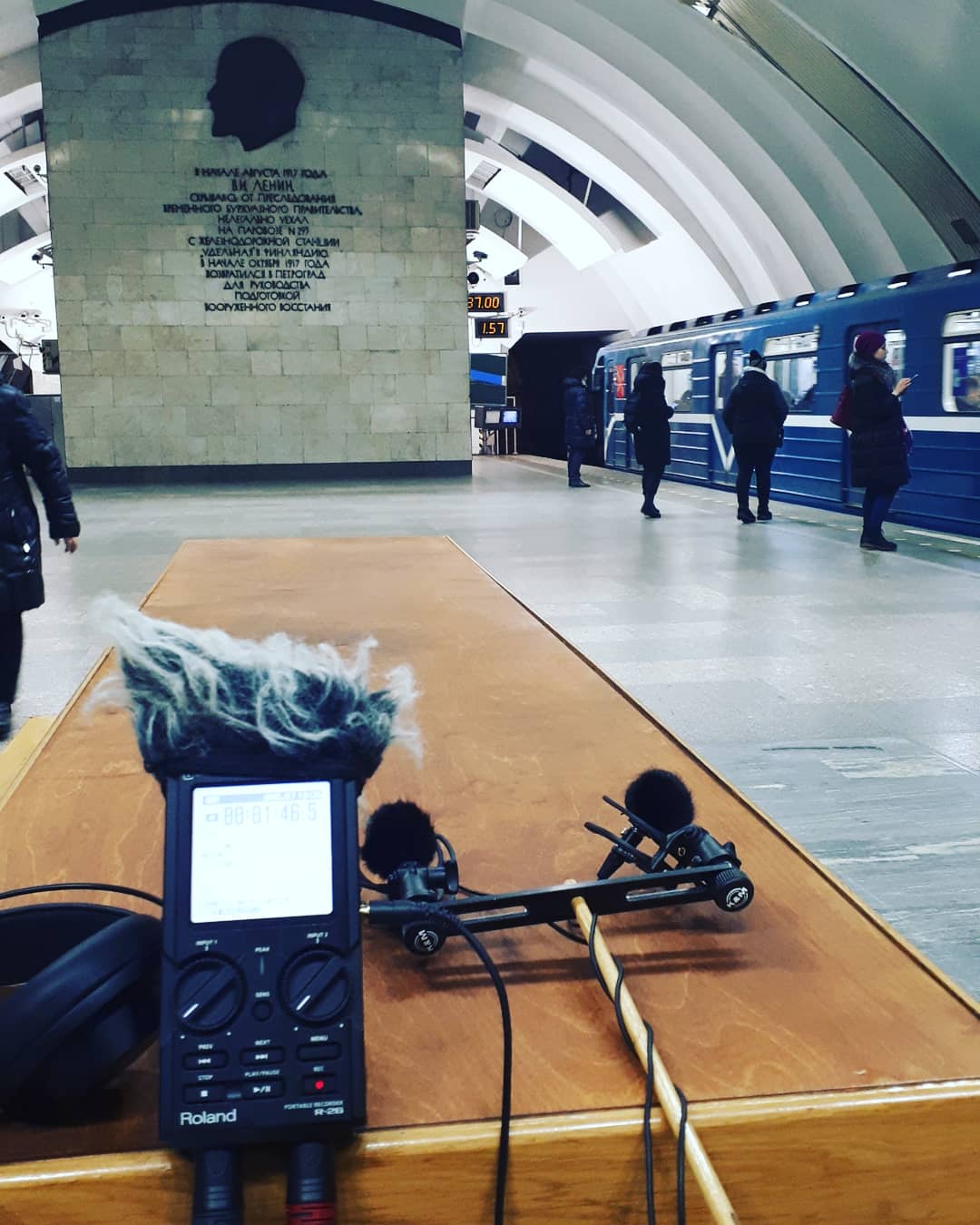
  • Field Recordings – recording urban sounds for ML datasets in St Petersburg and Moscow

St Petersburg

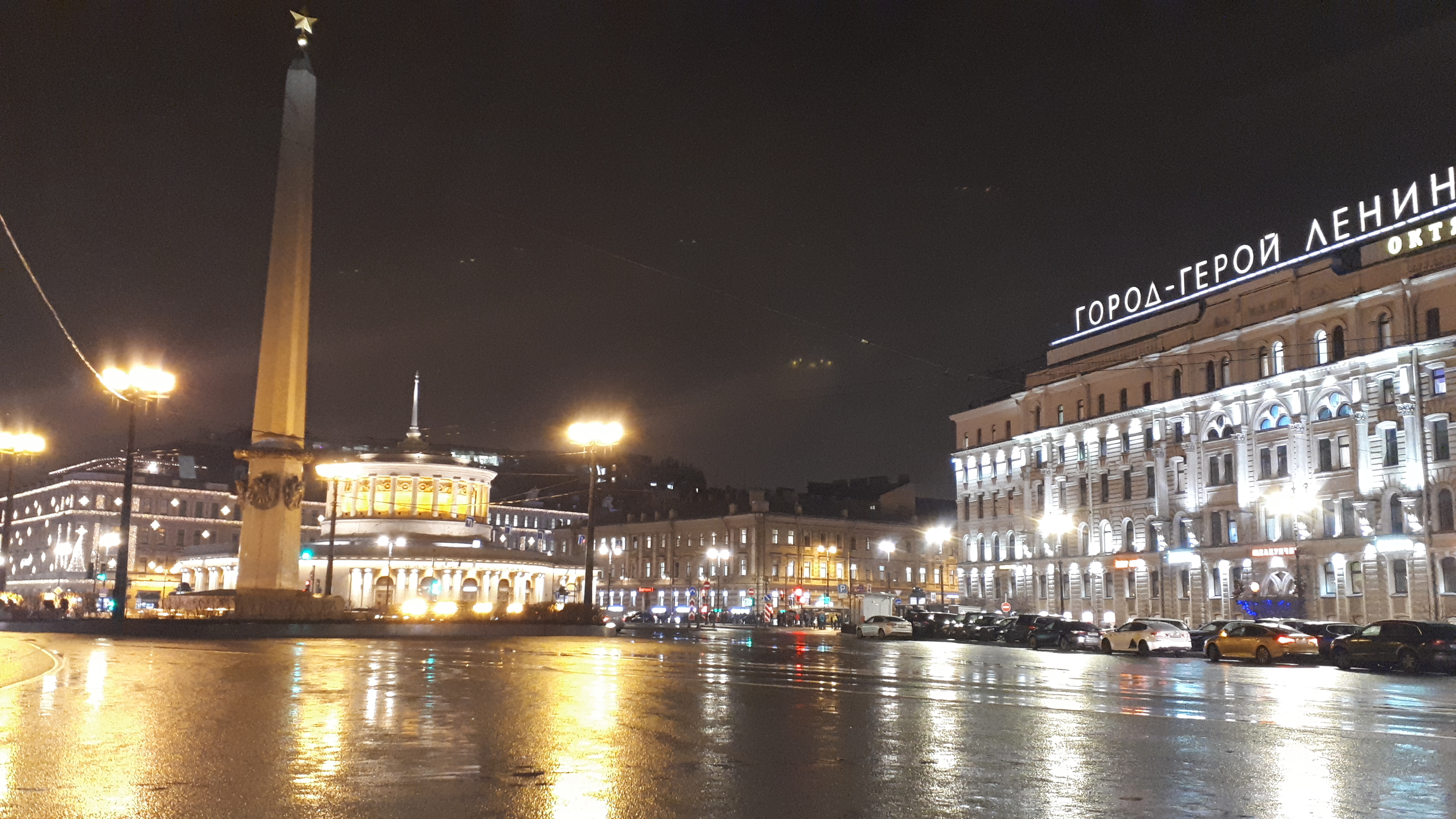
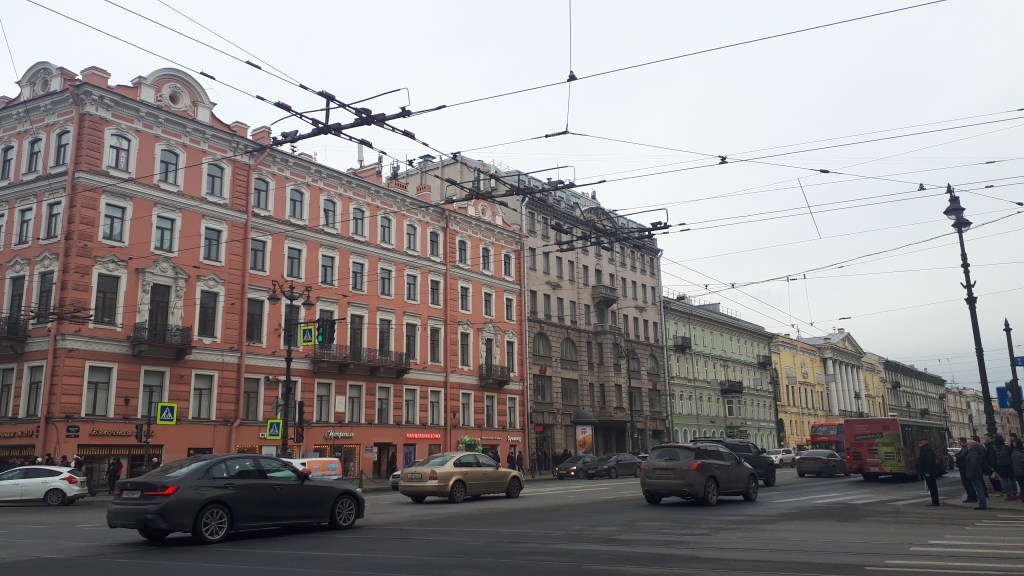
I arrived in beautiful St Petersburg to meet my host partner Ilia Symphocat, ambient composer, Simphonic Silence Inside label owner and curator of the Sound Museum to learn of his experiences and perspectives of performing with AI. On the first night Ilia took me to a DIY space for local artists for an exhibition opening from Nikita Panin, an artist working with visuals and machine learning. Nikita took inspiration from the inside of disk drives and considered the synergy of forms with Russian orthodox spiritual iconography. He trained a neural network on a dataset of 6000 sacred images and abstract paintings, presenting the outputs as large scale videos, prints and sculptures. The aesthetic of this was vibrant and pretty psychedelic and through speaking with Ilia’s artist friends, I learned that this visual style was quite typical of 90s St Petersburg rave culture. It was great to gain an insight into the local experimental arts scene and meet artists and musicians who were so welcoming and interested in our arts community in Manchester (especially Joy Division!)

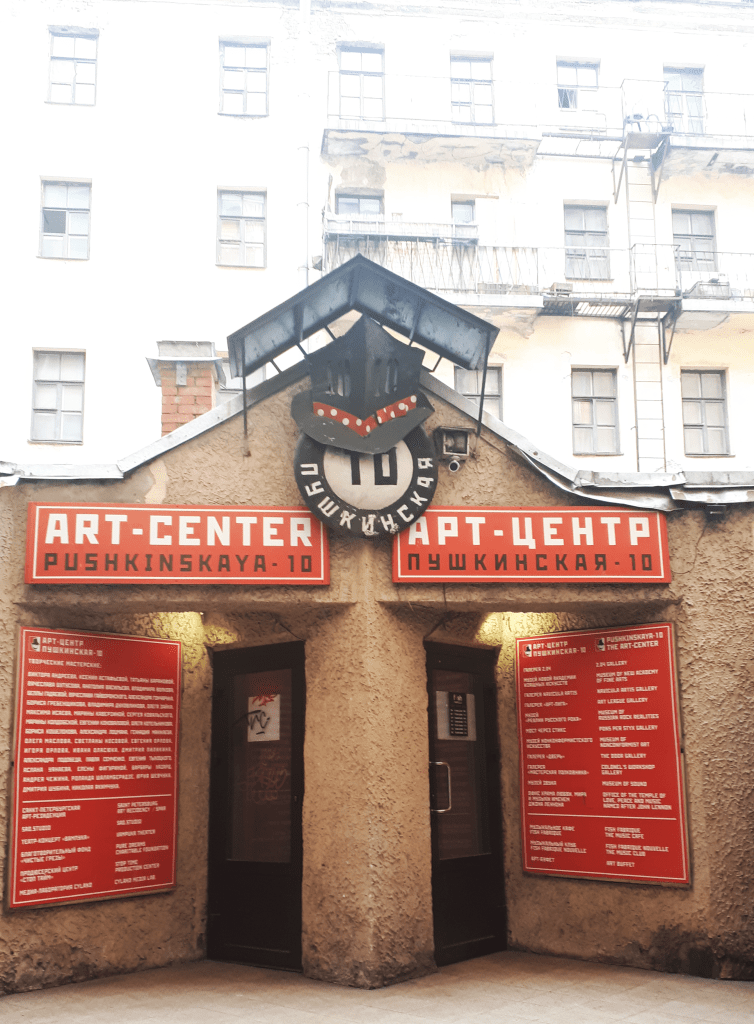
I spent time at the Pushkinskaya Art Centre 10, a legendary alternative complex housing many artist studios, museums and galleries including the wonderful Sound Museum and Museum of Nonconformist Art. I met curator Lora Kucher who took me around the current digital photography exhibition she had worked on featuring Manchester and Russian artists and spoke about their work and history.

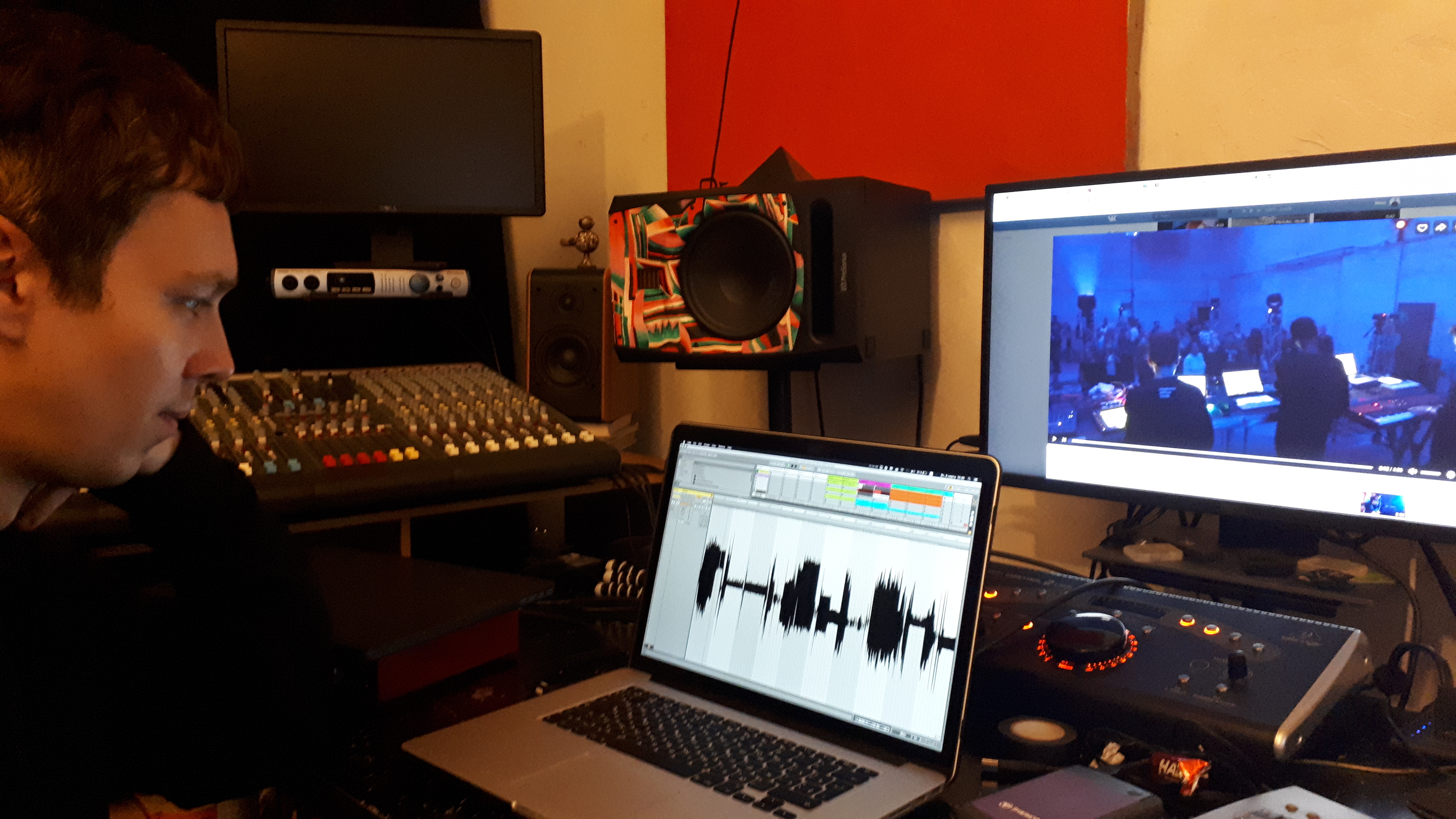
My host Ilia lived in the Pushkinskaya building having his studio there and working as the curator and events manager for the Sound Museum. Following some time recording objects in the museums collections, Ilia and I spent the day at his studio, talking and sharing our experiences of making music, performing and about our cities and music communities in Manchester and St Petersburg which incidentally are twinned cities. Ilia shared his experience of working with AI in live performance, he had worked with datasets of classical and jazz music which he reworked and improvised with in real time for his live set at Gamma Festival. We discussed how ‘live’ this can really be and the complexity and perspectives of working with this high level of technicality when you are a musician, as well as the importance of collaborating equitably with technologists.

Ilia Symphocat, Sound Museum

We performed at the Museum of NonConformist Art , a highly improvised and collaborative experience which we both enjoyed  immensely. Blending granulated field recordings and freezes with radio transmission fragments and some live objects. We had a good attentive crowd for a noisy Sunday evening in the gallery with Ilia hosting and introducing me and interpreting for the audience while I talked through the electronics and DIY interfaces I was going to play with. We worked with live visual artist Mikhail Mesyac who created a live digital backdrop to the set.

Other activities in St Petersburg included research on sculpture design through visiting the ‘Kinetic Art in Russia’ exhibition at the Grand Exhibition Hall which was hugely inspiring, charting it’s origins in constructivism to artists working with electronics in the present day, field recording around the city and with objects at the Sound Art Museum and working on music in my temporary airbnb studio! I found an amazing radio at the flea market on the outskirts of town, a Russian 303 with no aerial simply emitting white noise. I used this object as part of my performance with Ilia on the Sunday, combined with my field kit exploring and sampling the broken frequencies of each area I travelled to. It was my first time in St Petersburg and I loved the elegant city and the sparky people who were so welcoming and generous.

Moscow

I was excited to travel back to Moscow, it’s been five years since I was first here with Noise Orchestra, Dave and I had been researching 1920s noise machines and playing and making electromagnetic field recordings around town. I took the bullet train from St Petersburg very early in the morning, taking in the terrain between the two cities and pulling into Moscow, I forgot just how bombastic it is, the sheer scale and might of it. I enjoyed riding the garden ring at night and taking in the dramatically lit architecture and boulevards stretching off into the distance , I also remembered walks through Gorky park and quiet times recording on the streets around Tsvetnoy Bulvar and Patriarchs Pond.

Helena Nikonole and Nikita Prudnikov

I spent time with artist and curator Helena Nikonole and creative ML musician and technologist Nikita Prudnikov who are frequent collaborators on a range of projects exploring art and machine learning. One of their most recent collaborations Bird Language explores the structure of bird sounds through experimenting with neural networks. I had met Helena previously in Berlin on ‘The work of art in the age of artificial intelligence’ project at CTM and Helena had led the AI Hacklab for Gamma Festival. I was interested to discuss their experience of live sampling in AI,  practicalities of datasets and their applications (for example soundscapes v one shot sample libraries) and potential open source methodologies.

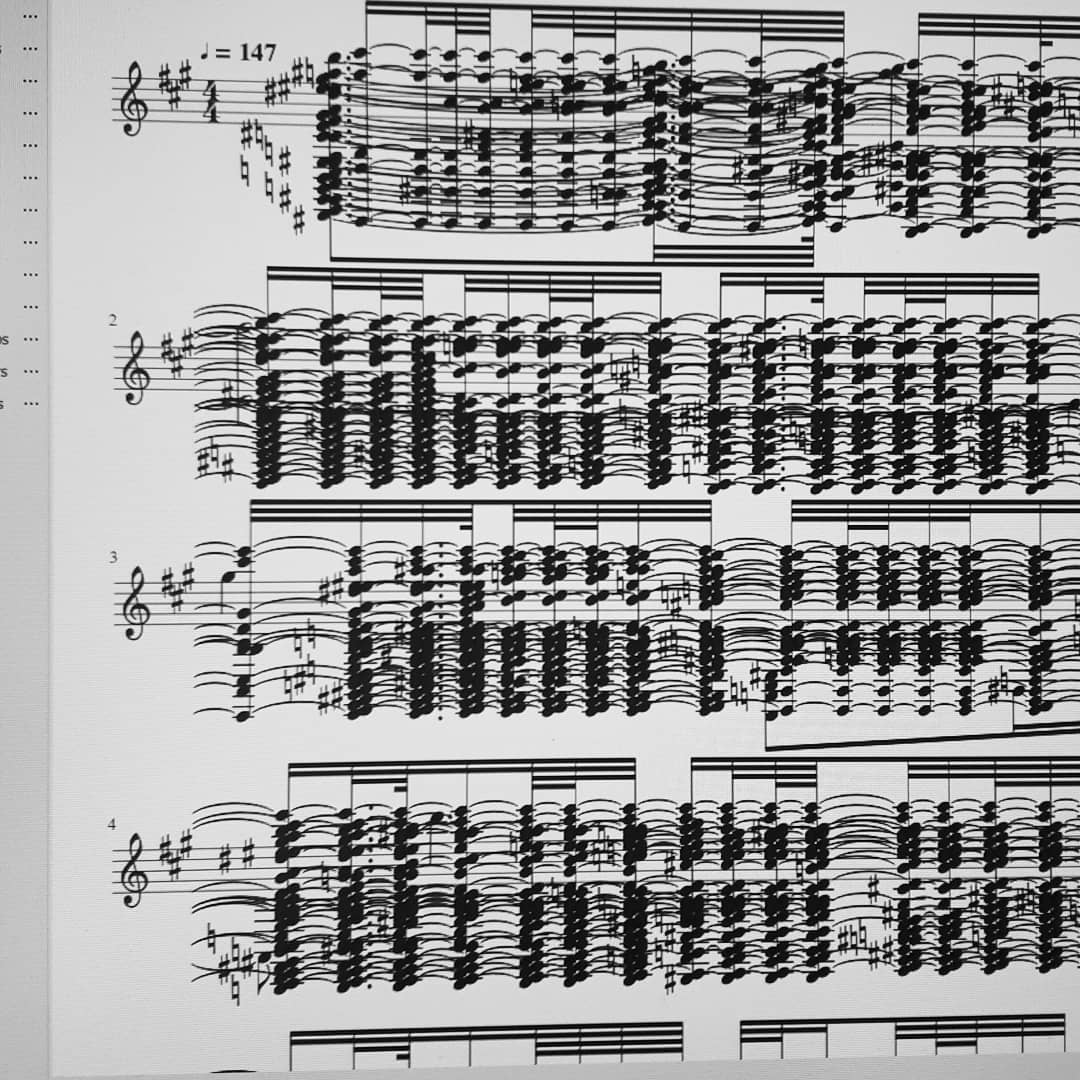
ML harpsichord score

I learned a lot practically and conceptually from Nikita and Helena around different neural network architectures from GANs to Auto-encoders and types of dataset. Nikita also shared a number of sounds and pieces testing these architectures some including voice, a call and response with an AI that was totally uncanny and quite eerie, a style transfer method featuring Brodski and footage of a live exhibition (Helena had curated) where he had performed with Katerina a harpsichord player. The sounds were unlike anything I had heard before and I loved the concept of working in latent space to seek timbres. I spoke about my work with radio frequency searching recordings and we discussed the parallels here with exploring space and working with fragments. It was also good to talk with Helena about our experience and the importance of genuine collaboration between artists and creative technologists when working in advanced fields such as this.

The twinned cities of Manchester and St Petersburg

Huge thanks to British Council for enabling me to undertake this trip. It was so inspiring to get to spend time with such amazing people, build connections between Manchester and St Petersburg/Moscow and learn about this field. In terms of my practice it has helped immensely with thinking about the next steps in project development for AURAMACHINE. Special thanks to Irini Papadimitriou and the FutureEverything team who supported me as my UK partner, and Tom Sweet and Evgenia Gerasimova from the British Council for their wonderful support.

#WEAREEQUALS

Feb 2020, Brighter Sound, British Council, MUTEK, Bridge_48, Barcelona

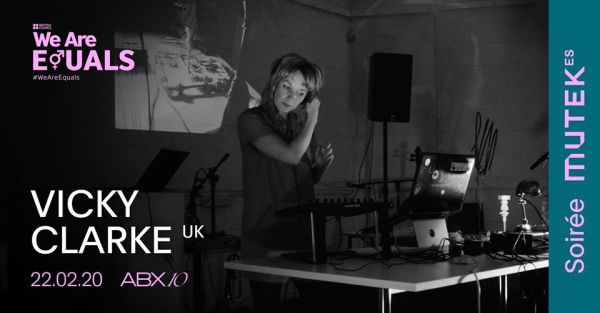
Alongside the fantastic CHAINES, I was invited by Brighter Sound and British Council to take part as a guest artist mentor for #WEAREEQUALS electronic music initiative for Mutek Barcelona 2020. Open to future leaders of the electronic music sector, this was a two day participatory programme where we gave talks and shared our personal experience of music making reflecting on our professional practice and UK networks and collaborative scenes. The aim of the programme is to support and promote women identifying artists within the sector and readdress the gender imbalance here specifically within electronic music. Brighter Sound’s Kate Lowes and Debra King curated the event and shared their expertise from their vital work from the Both Sides Now project. We were joined by the wonderful Jayne Styles from Music Managers Forum who shared her insight and expertise with the cohort around artistic development.

I was thrilled to perform on a NEON STAGE on the Saturday evening for the Mutek Soiree at the abaixadors10 club for the programme participants to kick off pre-festival. Thanks to Bridge 48 and Brighter Sound for this amazing opportunity, it was great to test out some of my new work in Barcelona.

Yemen: Say Hello to Connect

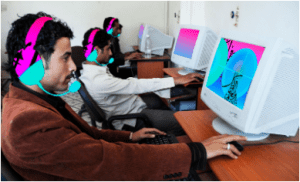
Inspired by internet cafe culture, Yemen: Say Hello to Connect is a travelling digital artwork exploring the interconnected themes of the humanitarian crisis through voice interactive storytelling and generative art. Commissioned by Imperial War Museum North and FutureEverything, the aim was to use digital technology to engage public audiences in dialogue about the crisis in public spaces across Manchester and encourage further visits to the ‘Yemen Inside a Crisis’ exhibition at IWMN exhibition.

The piece was a collaboration with spoken word artist Amerah Saleh and creative technologist Chris Ball, we also worked with KUNSTRUCT to realise the project within a physical pop-up structure. Reflecting curatorial content from the gallery exhibition and working closely with the IWMN team, the pop-up digital artwork explored interconnected themes of food and water insecurity, childhood and education, and transport and infrastructure through a storytelling narrative experienced through headphones and voice responsive visuals.

R&D_

I undertook early research into Yemen’s digital infrastructure, learning that before the crisis there had been an explosion of internet cafe culture, a  burgeoning economy for young independent business and how these cafes also acted as safe meeting spaces for women. Houthi rebels had seized control of internet pipelines in major cities across Yemen, so access and control of the internet was a contested and political area. Starting with the idea of an internet cafe, I wanted to somehow reflect this need for direct connection and create a physical pop up space people could come into and connect digitally via the network. Aesthetically I was inspired by nineties cyber cafe, vaporwave vistas and synthwave.

CONNECTING THROUGH STORYTELLING_

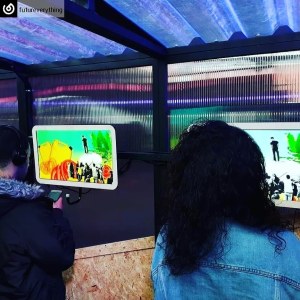
The conflict is an extremely complex and sensitive subject area and it was really important to consider tone and balance, working with Amerah and the Yemeni Community was key to thinking how we could best connect to the stories and realities experienced by everyday people. Amerah’s storytelling brought these experiences to life in a personal one on one dialogue, where we encouraged people to ‘take a moment out of their busy day’. The narrative journey begins when a user places headphones on and speaks into the microphone, saying ‘Hello’ to connect, triggering the opening narrative sequence that builds a picture of the crisis followed by an unfolding narrative with accompanying collage imagery.

This slideshow requires JavaScript.

LIVE POP UPS_

Pop up events took place at Piccadilly Train Station, Great Northern Warehouse, University of Manchester and HATCH. Each location had a different activations including with live performances and conversation cafes. We connected with the Yemeni Community Association in Manchester with Amerah Amerah running spoken word sessions with youth groups building towards a live performance at Manchester’s Piccadilly Train Station. Our partners Reform Radio supported us at our launch at HATCH and broadcast a live ‘Into Continental’ show hosted by Dr Mystery with live poetry, interviews and Yemeni soundtrack.

TECHNOLOGY & INTERACTIVITY_

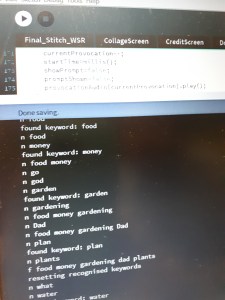
The interactive aspect of the piece encouraged users to put themselves in the place of Yemeni citizens and answer provocations, simply questions such as “How do you use water everyday?” or “What would you stop doing first if your water was limited?”. Your verbal response used voice recognition to trigger images on screen, creating a uniquely personal generative sequence in real time. To construct the digital piece, ensure connectivity and create the voice response interactivity I worked with Chris Ball, we tested various modes of voice recognition, creating word libraries for possible word combinations and keywords that related to collaged imagery. User testing took place at Manchester Technology Centre and each pop up ran four stations using mobile wifi networks. This verbal dialogue with the narrator asks us to consider the complexity and interconnectedness of the issues Yemeni people are facing. To bring the reality of the situation home, the artwork poses difficult questions for us to consider in the context of our own lives:

The live pop up events took place between May and September 2019. The piece was shortlisted for SXSW 2020. You can read more about the project on the commissioners sites here: FutureEverything and Imperial War Museum North

Special thanks to the team Jacquie Reich, Claire Shaw, Joe Ford, Jez Houghton, Joe Whitmore, Irini Papadimitriou and Camilla Thomas.

SLEEPSTATES.NET_Process Blog

SLEEPSTATES.NET: networked dream-intermissions throughout lockdown  Remote Residency, Manchester International Festival 2020

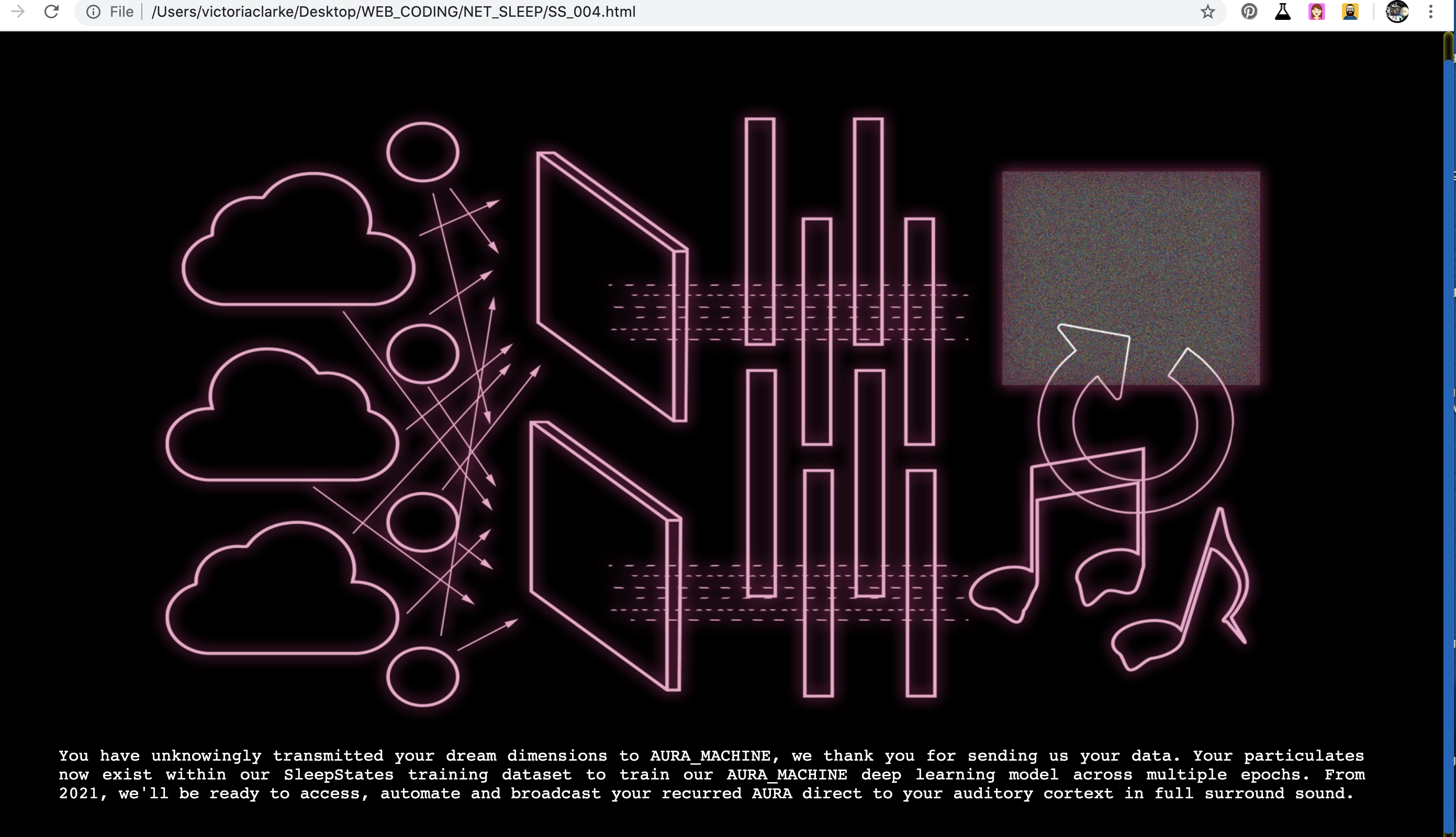
ABOUT_ SLEEPSTATES.NET is a work-in-progress browser based artwork where the user enters a virtual environment and navigates between different sleep states; a series of audio-visual moments capturing cyclical feelings of inertia, anxiety and online perpetuity experienced under lockdown. These networked dream-intermissions depict our quietly incremental machine addiction, these late night silent boundaries of questionable consent where algorithmic agents threaten to encroach on our states of sleep; our final autonomous, un-trackable human slumber space.

The sleep states will be realised using newly acquired ‘isolation skills’, learnt via online tutorials of HTML, Three.js and JavaScript programming languages; creatively exploring my theoretical and technical research into neural networks, machine learning and the ethics of training datasets. The sleep state art-work will develop in content, narrative and complexity relative to the developmental acquisition of creative coding skills during the remote residency. The work will be available in your browser at some point … in the near future ………………………………………………………

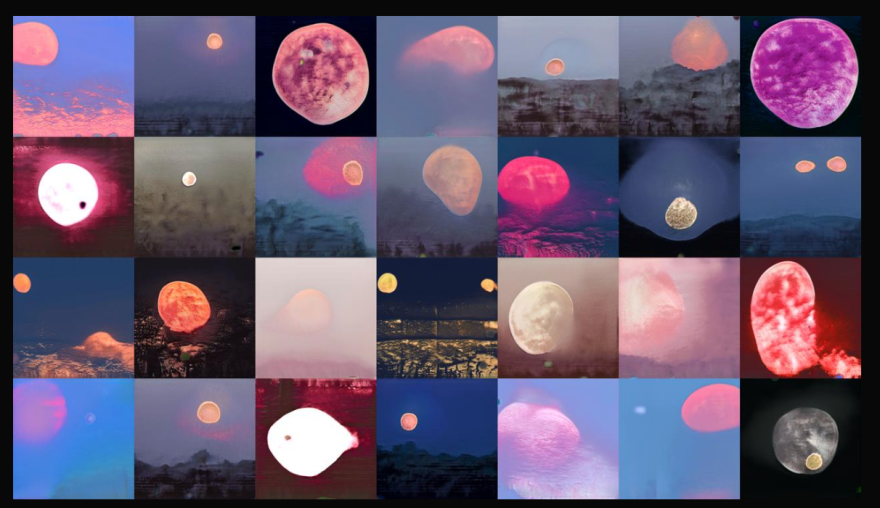
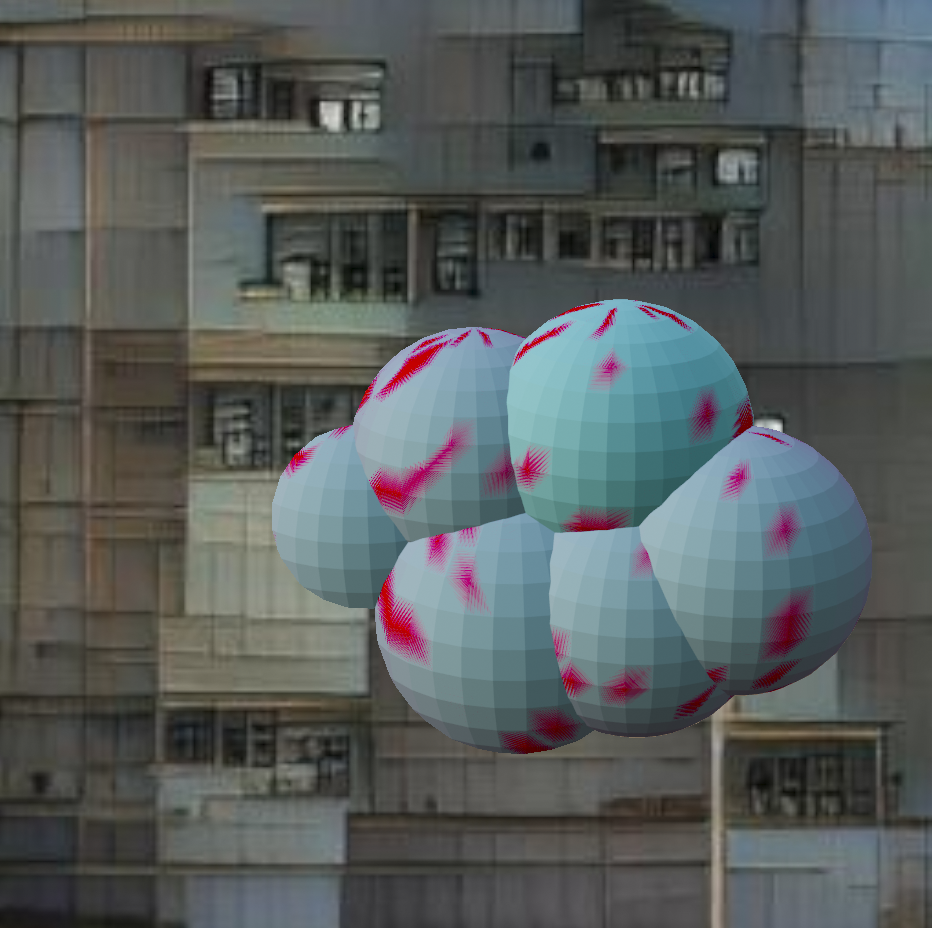
Opening screen featuring Pink Moon April 2020 visualisation_ generated by Machine Learning StyleGAN trained on 480 found internet images of April pink moon uploads.

CONTEXT_

Intermission………………………………………………………………………………………………………………………

Life on lockdown has disbanded all regular structures, routines and sense of time. We’re living in free_fall, whether working from home, the melding of weekdays and weekends, clocks going forward or simple concepts like bed_time. Our view of the future and the past has changed, this current condition seems hazy and perpetual with no end in sight; a cyclical recurring state where we are ‘on the cusp’ … of something. One thing is certain, our undeniable proximity to our computers and their hold over us.

Pink Moon explorations in latent space, machine learning experiments, April 2020 

Adding to our sense of inertia, we’re endlessly scrolling through the noise of social media, riding the rolling 24-hr apocalyptic news and witnessing daily governmental briefings where experts (yes they’re back) share data visualisations from outside reality. Sleep is so important to our sense of time, pace and regularity. It’s one of the structures we haven’t lost in this crisis, yet we’re struggling to sleep, sleeping too much, sleeping at unorthodox times or feeling inexplicable tiredness. Machines are systematically encroaching on our states of sleep, what can we do?

///// Dreams become days ///// Days become dreams ///// Zeros become onessssss…………

To try and make sense of this societal free_fall and as counter to the mass of data and statistics, SleepStates will document these changing emotions and mental states as we navigate through this intermission. SleepStates.net will collate this audio-visual content in an interactive online artwork that recurs the grammar of early net art and occurs contemporary digital surveillance tactics, seeking to reflect on our feelings of being online and displaced, connected yet remote, subjects ‘with’ complicity and the state of being in-between time.

SONAMB CORPORATION WANTS YOUR DATA_

Neural Network Architecture for AURA_MACHINE c. 2020

SONAMB corp. is a speculative AI startup who (as it will become clear) is powering the SleepStates interface. Whilst the user innocently navigates the different SleepStates experiencing a variety of sonic emotions, Sonamb is quietly extracting the user’s cognitive particulates,  collating the sonic-spatial-spectral frequencies of your auditory dreams to submit to a vast SleepState dataset. Developers are at the ready to beta test a ‘brand new for 2020’ convnet for forthcoming AURA_MACHINE;  a deep learning algorithm that will compute, predict and broadcast live sonic dream intermissions direct to your auditory cortex, in multichannel, for f(r)ee …. whilst you’re sleeping.

WORK IN PROGRESS_WEB CODING & SOUND DESIGN

For the project i’m learning HTML and CSS to create web content and styling for the different sleep states combined with P5.js and Three.js for interactive and 3D visual content. Sound design experiments and sketches will be shared to my soundcloud and combined with the navigable states as they develop. Cyclical narratives and interactivity will be completed before the site is hosted and available on the net.

DEMO STATES_

BACKGROUND ML_RESEARCH

SleepStates.net is a real time work-in-progress methodology to creatively explore my current research in music and machine learning and pursuit to develop my technical and conceptual understanding of this field. In 2019, I participated in the ‘The Work of Art in the Age of Artificial Intelligence’ programme at CTM festival, Berlin followed by further research into Wekinator ML with Dr Rebecca Fiebrink as part of ‘Decoding DIY’ 2019 from Live Art Development Agency/HOME. This year in March 2020 I undertook a creative research trip to Moscow and St Petersburg as a selected artist for British Council’s UK-Russia Year of Music, meeting artists and technologists working in this field including Ilia Symphocat, Helena Nikonole and Nikita Prudnikov and supported by FutureEverything, I’m currently studying ‘Introduction to AI and Neural Networks’ course at the University of Karlsruhe within the KIM ‘Critical Artificial Intelligence’ research group, led by Professor Matteo Pasquinelli, focused on media philosophy, technical history and contemporary ethics around current AI practices and societal implications.

Screenshot 2020-06-17 at 21.15.13

SleepStates work in progress features at the end of a ArtistsDIY lockdown feature I did with FACTmag

Thank you to Manchester International Festival for supporting this remote residency. #MIFCreatives2020

MIFLogoBlack

Sonic Futures Documentary

My work was featured in new SONIC FUTURES: HOW TECHNOLOGY IS GUIDING MUSIC documentary from FACTmag and British Council Music.

Images and information about the documentary

The British Council and FACT have released a new mini-documentary about British technological innovation in electronic music that explores how contemporary UK artists are looking to the past, present and future to create new sounds and utopian spaces.
Sonic Futures: How Technology is Guiding Electronic Music speaks to several British artists at the cutting edge of composition, coding, engineering and performance: sound artist and DIY musical interface builder Vicky Clarke; producer Lee Gamble; composer and hacker Venus Ex Machina; interdisciplinary artist and Algorave musician Lizzie Wilson aka digital selves; and queer club collective Tremors.
https://www.factmag.com/2019/10/22/sonic-futures-how-technology-is-guiding-electronic-music/
The film explores how contemporary UK artists are using machines and code to facilitate new forms of collaboration, whether musicians should be afraid of machine learning and artificial intelligence’s movement into composition, and how music technology has the power to liberate individuals and bring marginalised communities together.

“In terms of the British history of electronic music we’re a nation of hobbyists and tinkerers and we like to build and make things,” says Manchester-based sound artist Clarke, whose DIY physical interfaces for controlling digital sound are part of a dialogue with the UK’s electronic music history spanning back to the foundation of the pioneering BBC Radiophonic Workshop in 1958.

Produced by FACT in association with the British Council
Directed by Anoushka Seigler
Edited by Kamil Dymek
Shot by Pawel Ptak and Pedro Kuster
AI: More Than Human footage courtesy of Barbican
Archive footage courtesy of BBC
Program advisors – Claire Lobenfeld and John Twells


AIDF PART 2: BERLIN 2019_ Art/Science. AI, Algae & Make Believe

BERLIN 2019

MUSIC TECH_AUDIO-VISUAL_SCI-ART SCENES

ARTISTS INTERNATIONAL DEVELOPMENT FUND

VICKY CLARKE 

_______________________________________________________________________

PART TWO: ALGAE, ARTIFICIAL INTELLIGENCE & MAKE BELIEVE
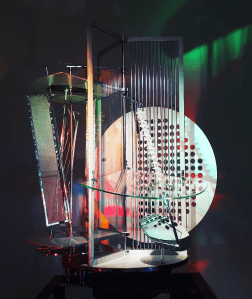
Kapitel Zwei from my 2019 creative research trip to Berlin on the Artists International Development Fund. This year Germany celebrates 100 years of the BAUHAUS with a nationwide programme of events celebrating the radical art school that transformed design, architecture, photography and art-school practice. Back in January, my arrival chimed with the opening of 100 jahre bauhaus; the light, sound and motion exhibition at the Akademie der Künste seemed a befitting start to my research into transmedia programmes in the city. The Licht.Schatten.Spuren show featured kinetic, sculptural and sonic works by Lázsló Moholy-Nagy and contemporary artist-scientists exploring the interplay of light and shadow. An ensemble of original artworks, remodelled pieces (including my favourite ‘Light space modulator’) and new commissions from contemporary artists including Christian Boltanski and Tim Otto Roth. The exhibition traced the lineage and influence of the Bauhaus upon today’s interdisciplinary artworks, and how even in the era of technological advances in AR, VR and AI, this spirit of making work at the borders maintains the potential to produce the most visceral art that depicts the culture of our times, the true meaning of zeitgeist.

STATE STUDIO
A present day example of this critical dialogue at the borders of art and technological is STATE Studio in west Berlin. Occupying a new gallery space on Hauptstrasse, STATE is a ‘festival, gallery and agency for science, art and innovation who connect people with science in novel ways’. My first visit was for the opening of ‘Field Experiments’ an exhibition series showcasing provocative artistic works across the fields of science, art and society. The centerpiece of the exhibition was ‘Living Canvas’ an installation by artist and designer Faro Peluso. The piece is a giant living canvas-sized algae experiment (complete with water irrigation system), a piece of speculative design challenging the viewer to contemplate the importance of sustainable energy in cities and how algae could be harnessed in urban design to breathe air into our future cities. Faro collaborated with Solaga, a Berlin-based biotech firm to create the algae biofilm. A few days later I got hands on attended the ‘Algature Workshop’ learning how to grow your own algae biofilm and discussing Solaga’s bio-technology work making ‘living walls’; panels of microalgae biofilms that are low in energy and suitable for cleaning at low concentrations that offer potential for urban and biological air purification. Imagine a future city with giant architectural algae structures or hanging an algae picture in your front room to cleanse the air.

I met with STATE Director Christian Rauch, who is passionate about this approach to connecting artists, research and the public in critical dialogue around science and society, and is building a really dynamic programme at the space, exemplified by their new ‘Artist in Lab-Dualität’ an applied research programme where artists and designers link with Fraunhofer institutes to create and disseminate work. I kept returning to STATE during my trip for free talks and meet ups including the Disruption Network Lab and a CTM Music Makers Hacklab talk on cybernetics, I highly recommend checking out STATE Studio’s fascinating programme.


THE WORK OF ART IN THE AGE OF ARTIFICIAL INTELLIGENCE

Conceptual Research Project: Programmed by CTM Festival, hosted by Art Laboratory Berlin 
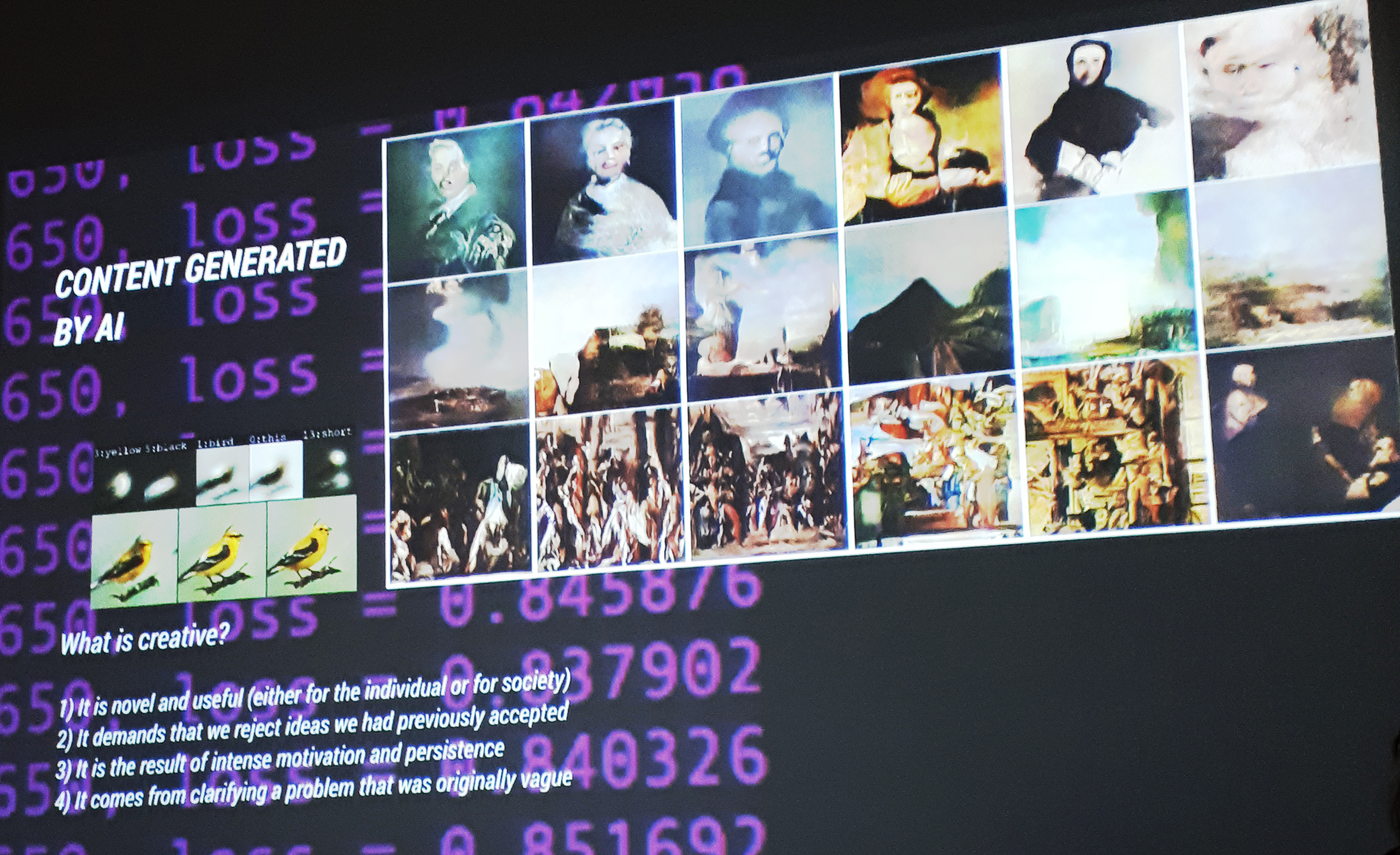
Image from Helena Nikonole’s AI workshop

Led by curator Natalia Fuchs, media art historian and founder of Artypical, and new media artist Helena Nikonole who’s piece ‘dues X mchn’  explored networked surveillance cameras, IoT and sacred texts was currently on show as part of CTM Festival’s ‘Persisting realities’ exhibition, I was one of ten artists to take part in the programme, the criteria being to propose a project utilising AI. For me relatively new to this discipline it was a chance to learn about the history of AI within arts practice and gain an insight into the tools, contexts and contemporary perspectives surrounding the field.  My proposal was to create an AI performative sound sculpture that used concrete objects, sampled sound, live radio and machine learning to reflect on Walter Benjamin’s critique around the ‘cult of the original object’ in his essay ‘The work of art in the age of mechanical reproduction’. 

The programme was fascinating, Natalia versed us in the role of the artist as interface and activist, using art to navigate and interrogate contemporary contexts and dynamics around AI including power and surveillance, data set bias, ecology,  control and manipulation. 


AI as an artistic field is growing so fast due to big data, computational power and ready access to machine learning tools. We discussed the aesthetics and growing field of the ‘AI artwork’ from a visual perspective and the ‘hype curve.’ In a rapidly evolving field where the technology is advancing so fast, a very real concern for artists is that of producing work which has the potential to date very quickly as the technology and critical discourse advances.  With this in mind, Natalia shared insight from a curatorial perspective where models for AI exhibitions such as ‘Open Codes’ at ZKM, and the ‘More than Human’ exhibition at the Barbican are addressing this by implementing innovative strategies for the exhibits and exhibition content to evolve over time to respond to these changes. This summer Natalia, Helena and Peter Kirn hosted Gamma_Lab AI bringing together musicians, coders, mathematicians and computer scientists with live outputs performed at St Petersburg’s Gamma Festival.

AI and music are hitting the headlines in 2019 with leading electronic musicians such as Actress and Holly Herndon exploring this field in their new live shows. I’m interested in continuing my learning from this AI course and the ‘Machine learning for sound artists’  course at Koma to develop my skills. One thing that stuck with me was the idea that artists can play a role in imagining future social purposes for AI – subverting the power hierarchies of tech companies and how AI could be a democratic source of power for the people.


SCHOOL OF MACHINES, MAKING & MAKE BELIEVE  

Micro-dosing diaries, consciousness and collectivised communist role play in video games, just some of the topics and presentations at the ‘Cake and Conversation’ event at School of Machines, Making and Make Believe headquarters at ACUD, Prenzlauer Berg. Our host School of MA founder Rachel Uwa welcomed us to the studio space, an arts & tech den packed with equipment, books and sculptures including some giant fluffy heads from a previous augmented reality project! The attendees listened to fascinating presentations on the above subjects and discussed the themes over cake. Sounds like a simple concept, it was … and it was great. As Rachel said  “I hate small talk, let’s make time to talk about ideas and things that matter with strangers.”

A couple of weeks later I visited Rachel to find out more. School of MA has a stellar programme based around four week projects bringing creatives together over contemporary technological and societal issues, as it states on their website, ‘ Technology is fascinating but, more importantly, who are we and what do we care about?.’ Usually held in Berlin over the summer, themes have included experimental gaming, eco acoustics, data surveillance and future cities. 2019 sees the School of MA go international with their courses ‘Made in China’ in Shenzen in collaboration with SEEED Studios and ‘Future Landscapes’ at the National University of Ireland. Tutors are selected as world leaders in their field and the programme attracts participants from all over the world.
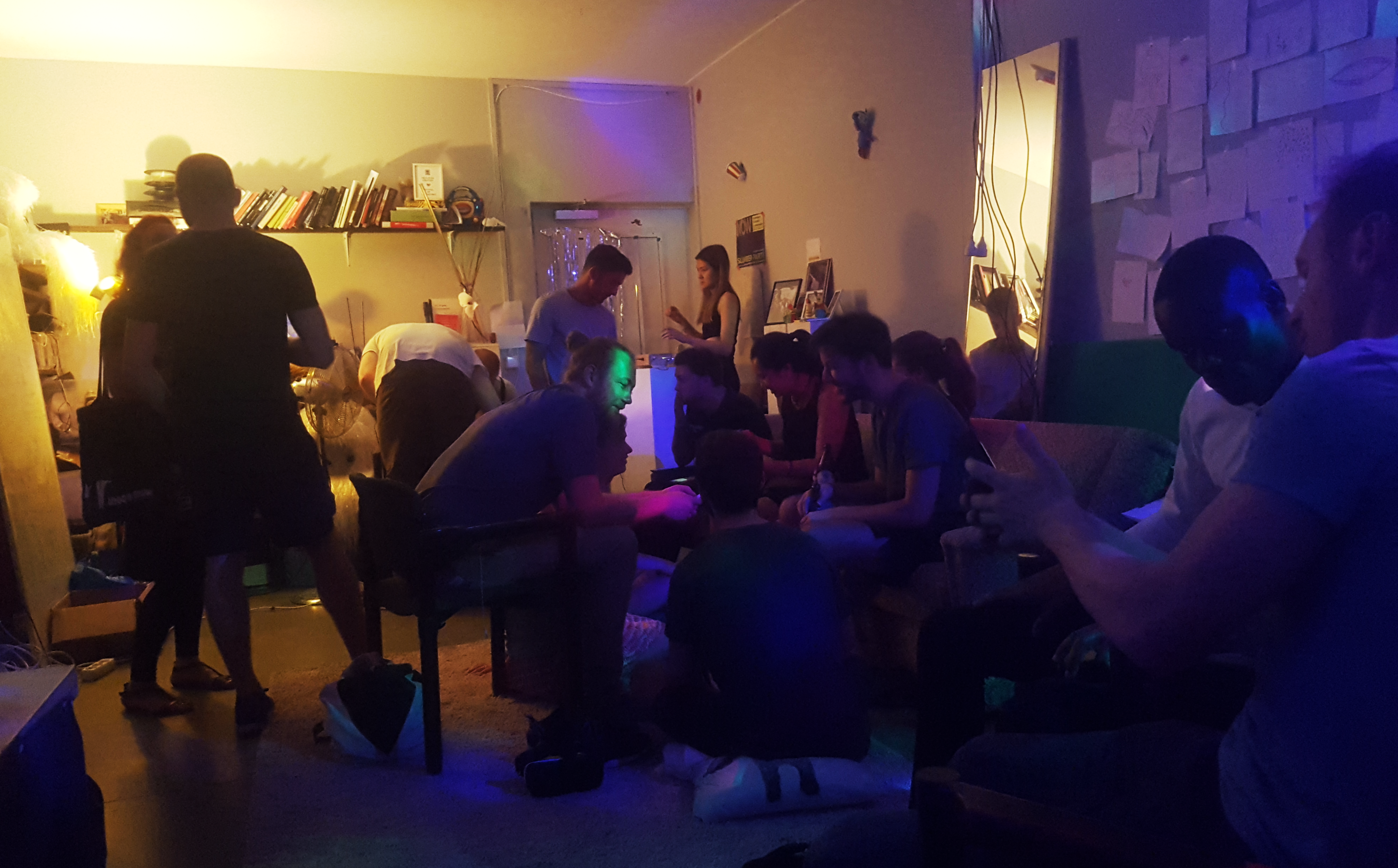
Rachel is interested in continuous learning, what we once called ‘life-long learning’ in the UK before (before our creative adult education provision was drastically cut.) Tired of one or two day courses where you learn a new skill, software platform or thematic area, Rachel devised the four week programme structure which enables the acquisition of practical skills in say coding, machine learning or AR/VR which is then applied practically through the realisation of a  creative project or collaboration – embedding what you have learnt. It also allows for a more in depth conceptual discussion and rigour with experts and fellow artists. Projects coming up include ‘Evidence’ introducing critical discourse around citizen forensics and ‘Waiting and Escaping’ on the fundamentals of spatial design. Above all you are encouraged to make believe.


FACTORY
I met up with my friend Rania aka musician and artist PortraitXO, who gave me a tour of Factory, a new space at Görlitzer park for creative tech startups and increasingly arts production. Described on their website as an international community of innovators – the brightest minds from tech, politics, art, and science together into one collaborative ecosystem’, the building is one of two large campuses in the city (main space in Mitte), reflecting Berlin’s reputation as startup capital of Europe. Named after Warhol’s New York Factory, this is coworking on heat with an elegant library, playground (including ball pool, sleeping pods and obligatory ping pong), exhibition spaces and I spotted people quaffing lattes sitting in dolled-up wheelie bins (true).  As members; organisations and individuals have access to network and pitching opportunities, training, skill-sharing and a whole host of social events made to aid collaboration. 
Rania is the first artist in residence at Factory and is keen to bring in creativity and art to the building in spades. When I went to meet her she was testing a new AR app on her phone made by one of the neighbouring startups, animating the environment. I first met her at Music Tech Fest Stockholm last year, listening to her talk as a music artist with synaesthesia between taste and sound. That week she was working on an audio-visual installation in the cafe and performance spaces based on this work and recently has collaborated with Dadabots on an AI/Vocal duet as PortraitXO. I’m interested to see how she continues to explore the dynamics of the communities, companies and start up technologies artistically in the space, and how the artistic and commercial innovation models play out. With interesting programming such as music tech event The Creative Code, talks such as ‘Consumed by the internet, an event on digital addiction’ plus recently launched artist open call with links to Sonar festival in Barca, things are looking sparky over at Factory. 

BERLIN BIS SPÄTER

Here concludes my brief insight into the music tech and art-science scenes in Berlin 2019. I’ve loved the opportunity to spend a prolonged period of time in my favourite city, making music and meeting friends old and new. The streets, the humans, the machines the spirit of the place, it’s been an incredible experience I’ll never forget. 2019 also marks 100 years since the German revolution with a ‘100 jahre Revolution Berlin 18/19’, a city wide programme of events and exhibitions exploring democracy, freedom and protest.

Coming from Manchester another politically and culturally radical city, i’ve been thinking a lot about just what gives a place cultural significance and creative dynamism. I finished my trip with a visit to the British Council at no. 1 AlexanderPlatz, to share my findings and provide insight into the art scene of my home town, re-energised In the knowledge of the power of cultural exchange and understanding through art. Thank you Arts Council England and British Council for this Artists International Development Funding.

Berlin, Bis Später x