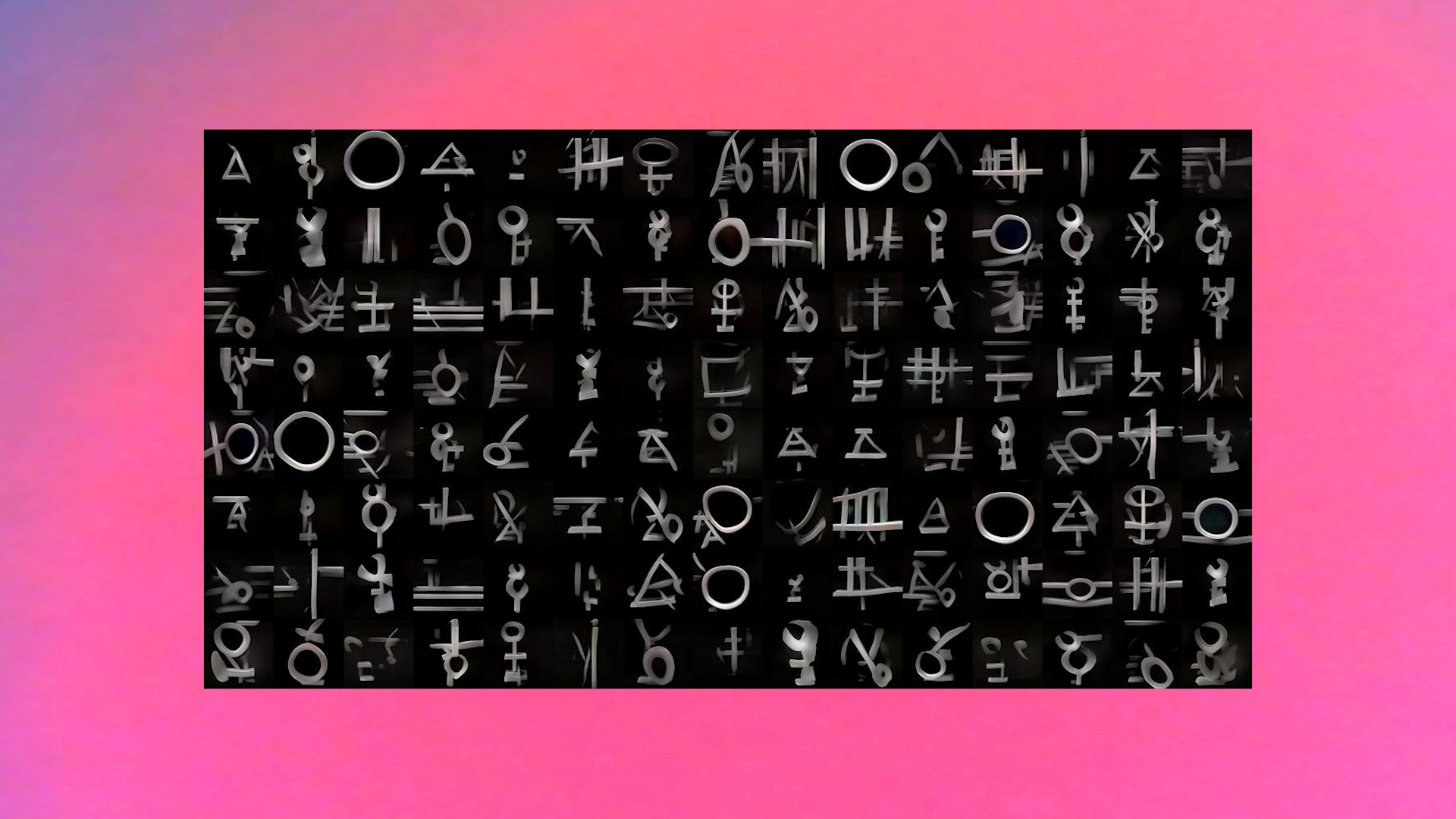
Artefacts of clay and information explores the limits of our material perception. Questioning the things we see, hear and believe through tuning in to unseen forces just beyond the threshold of our reality. Traversing the borderline between the geologically real and the electrical imaginary, these artefacts of clay and information help us to explore this moment of transference and our place as human transmitters and receivers within the electromagnetic spectrum of existence.
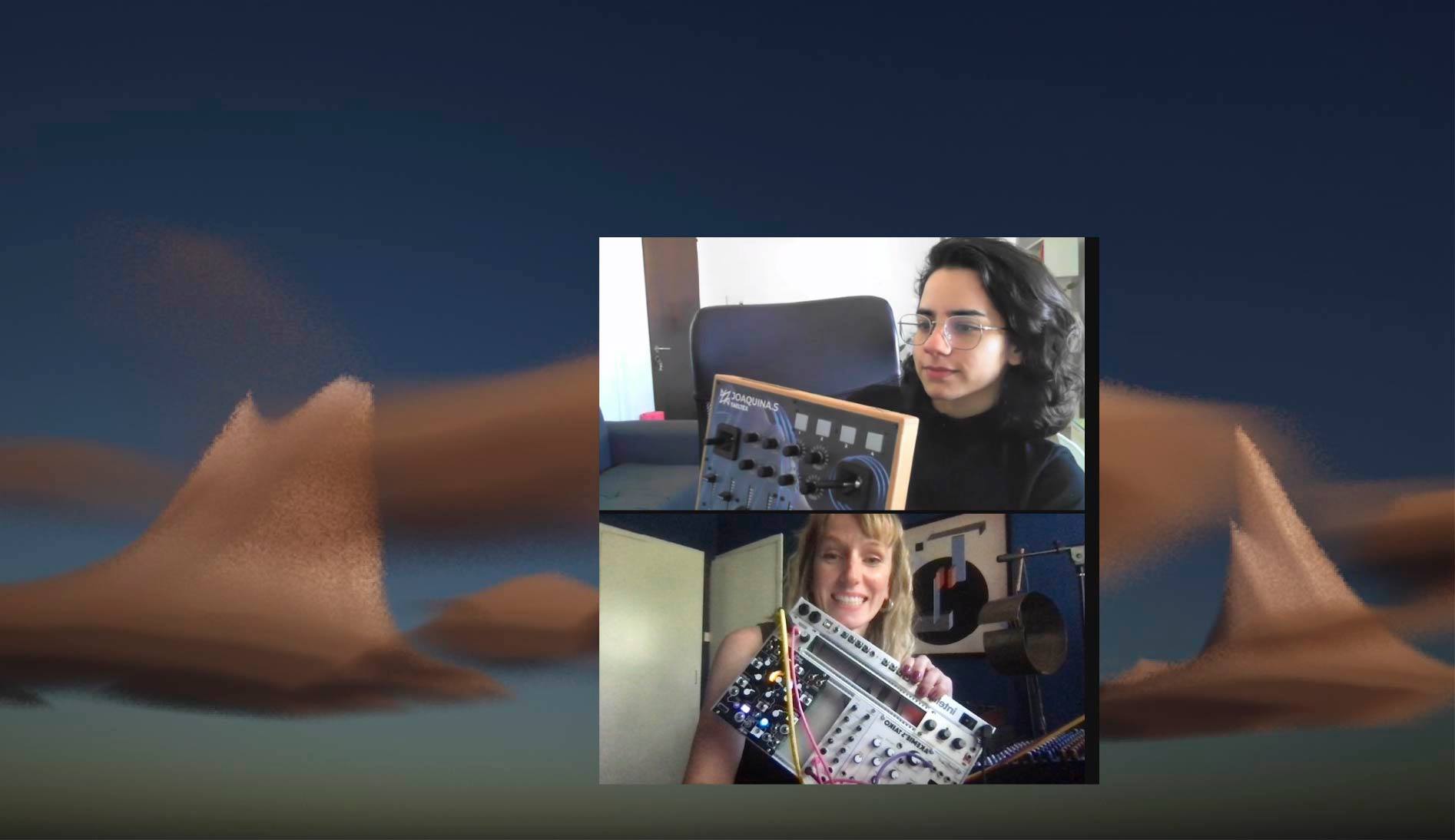
Artefacts of Clay and Information is a collaboration between Vicky Clarke (UK) and Joaquina S (Argentina). This international collaboration is part of AMPLIFY DAI connecting women working in digital and sound arts, we have been developing the piece entirely online throughout the pandemic. This prototype was created for MUTEK Forum 2021, and is a first stage proof of concept. Our collaboration is now in a new phase of development for realising this piece for live audiences, updates coming 2022.
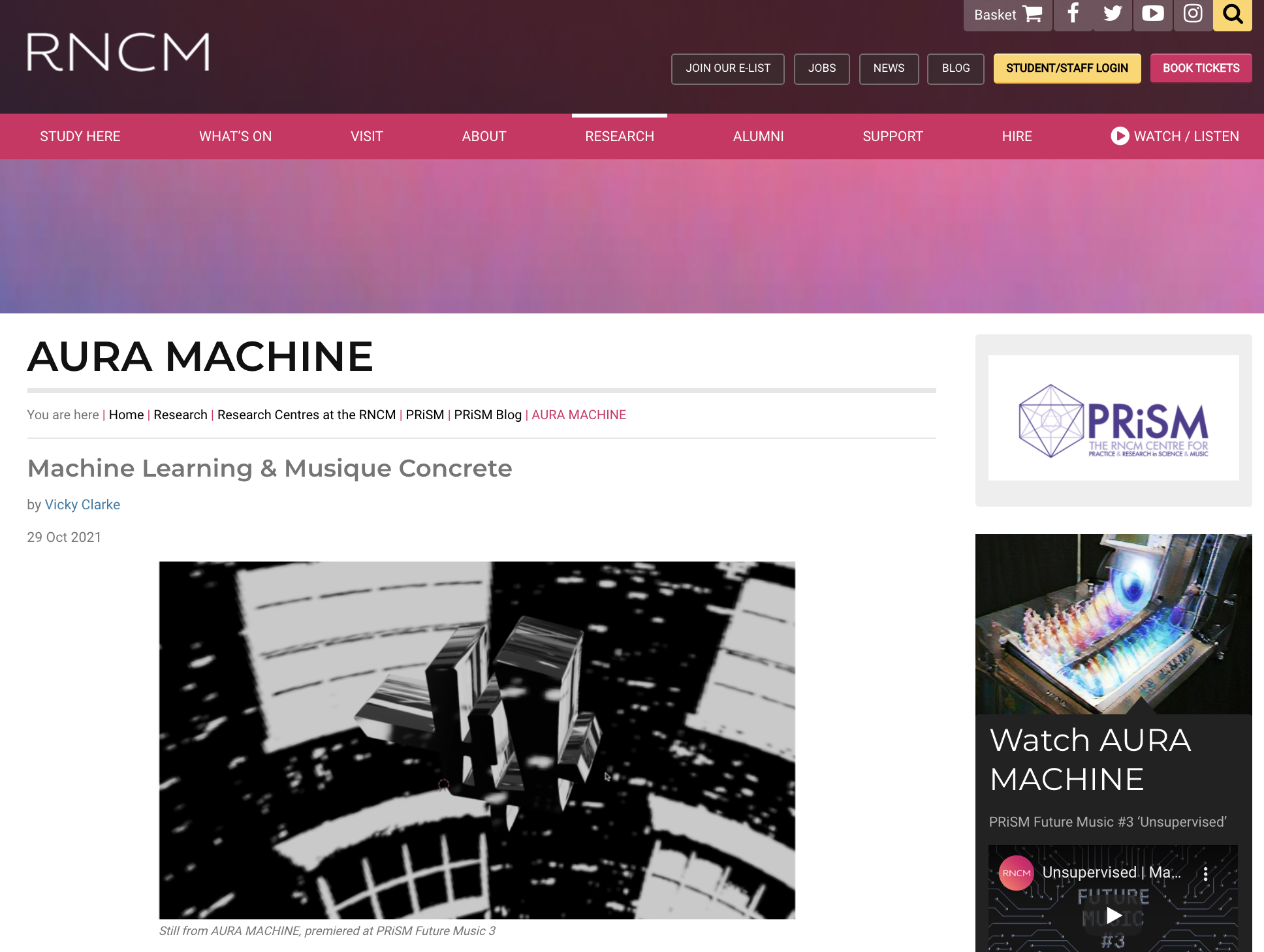
Delighted to have an article published for the PRiSM blog at RNCM. The piece charts my research and process so far exploring machine learning and musique concrete on my NOVARS residency, University of Manchester in collaboration with PRiSM. Leading up to my first experiment in neural synthesis AURA MACHINE which premiered online as part o f FutureMusic3 in June 2020 Read the article here
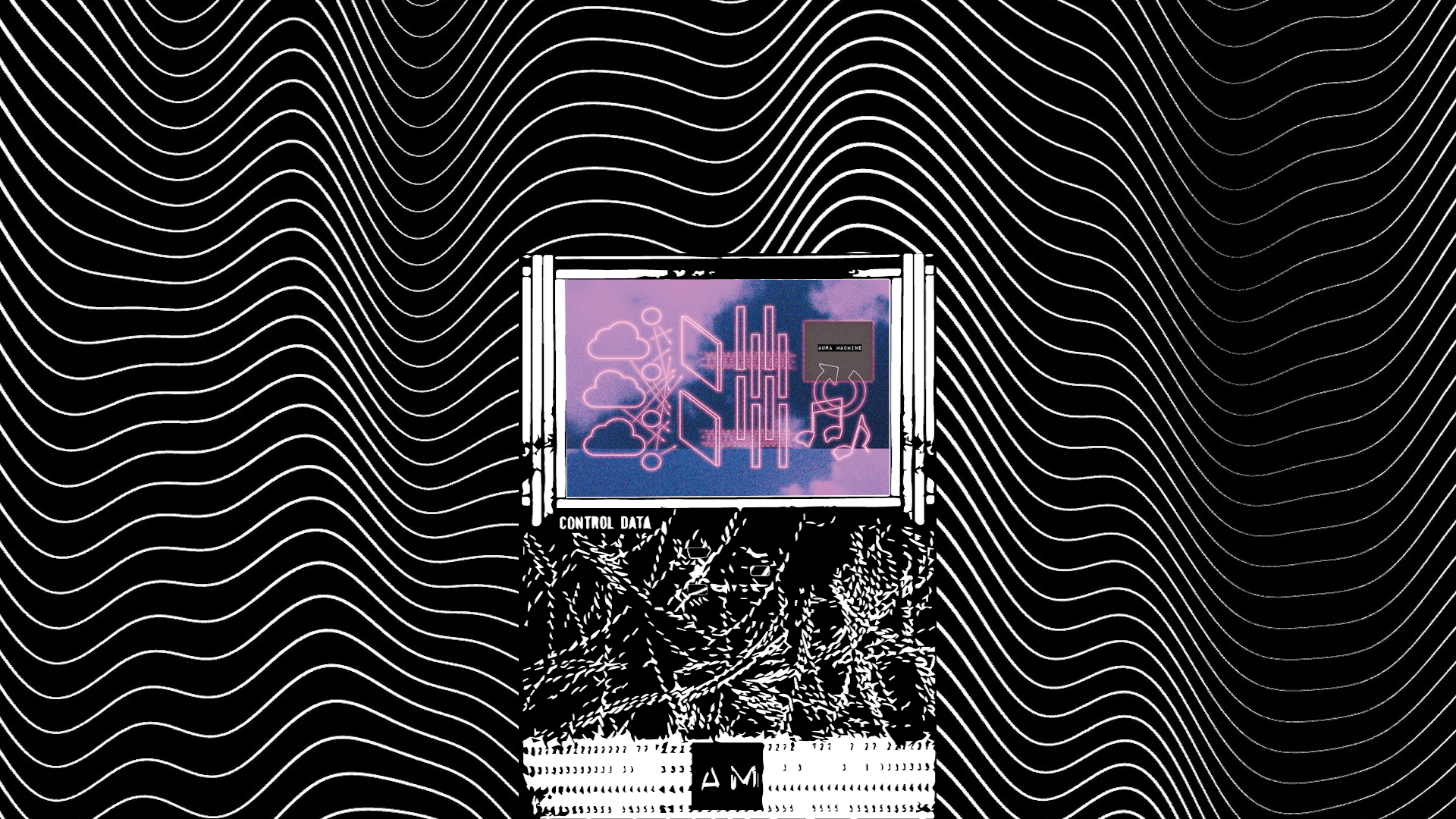
Very excited to premiere AURA MACHINE my first sound work using neural synthesis at Future Music 3, Royal Northern College of Music. Taking place online the event will showcase new works from artists in UNSUPERVISED our brand new machine learning for music group between NOVARS and PRiSM.
AV piece from my musique concrete and machine learning research residency with NOVARS, centre for innovation in sound, University of Manchester in collaboration with PRiSM. The piece premiered at PRiSM FutureMusic3 event, Royal Northern College of Music, June 2020 alongside works from our UNSUPERVISED machine learning for music working group.
About the piece_
‘The genuineness of a thing is the quintessence of everything about it since its creation that can be handed down, from its material duration to the historical witness that it bears.’
The Work of Art in the Age of Mechanical Reproduction, Walter Benjamin
A sound object has an aura.
Taking the starting point of the sound object, a sonic fragment or atom of authentic matter, what happens to this materiality when processed by a neural network? What new sonic materials and aesthetics will emerge? Can the AI system project newly distilled hybrid forms or will the process of data compression result in a lo-fi statistical imitation?
For this piece, my first experiment with neural synthesis, I sought to collide the two disciplines of musique concrete and machine learning to take the listener on a journey through the process of training a SampleRNN model.
A tale of two states, AURA MACHINE begins with the training data, the original source material comprising the concrete dataset. Field recordings were categorised into distinct classes; ‘Echoes of Industry’ (Manchester mill spaces), ‘Age of Electricity’ (DIY technology, noise & machinery) and ‘Materiality’ glass fragments and metal sound sculptures. The second state is the purely generated AI output audio.
Can a machine produce an aura?”
AURA MACHINE residency article written for PRiSM, Royal Northern College of Music: READ HERE
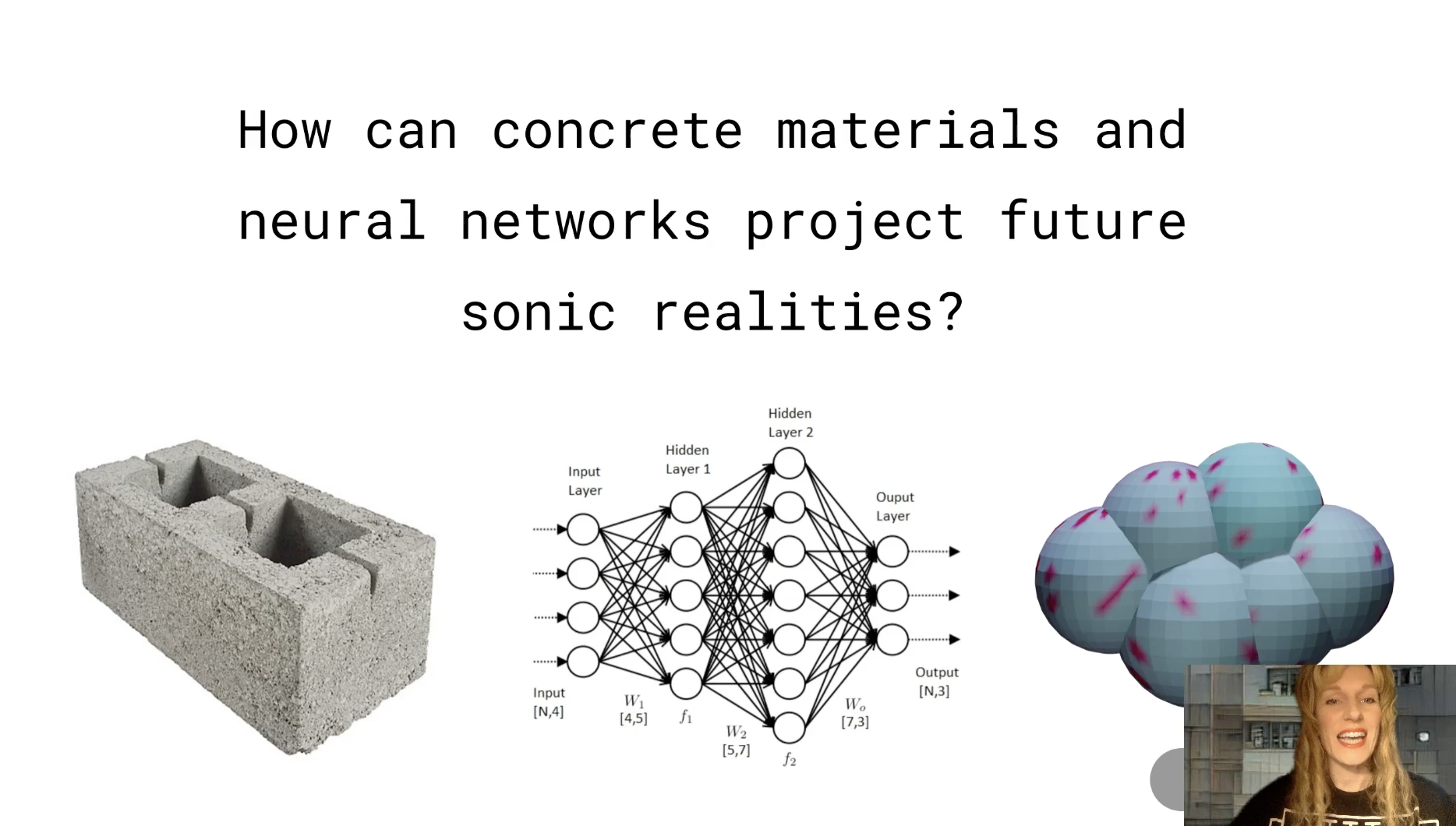
I’m joining NOVARS Research Centre for Innovation in Sound at the University of Manchester as artist in residence to explore systems for machine learning and musique concrete 2020-2021. The residency is part of European Art Science Technology Network for Digital Culture a partnership with 14 EU institutions. My research question is “How can concrete materials and neural networks project future sonic realities?”
Building upon my conceptual research into ML and music, the residency will allow me time, space and support to develop my technical skills in order to create my own systems to realise the idea for the AURA MACHINE neural network. The AURA MACHINE architecture takes inspiration from Russian projectionism, thinking around Walter Benjamin’s aura of an object, musique concrete and sample culture.
I’ll be creating a training dataset of concrete materials and echoes of industry and processing through generative neural network architectures, considering process, acousmatic sound and issues of bias, labour and automation at each stage of system development.
I’ll be using Python and Max to create ML systems for sound sculpture and live electronics and am really excited to be collaborating with the wonderful people at PRiSM, Centre for Practice & Research in Science & music at the Royal Northern College of Music through our new ML and music working group across the two institutions. I am really looking forward to being part of this new creative community for machine learning in Manchester and gaining support and insight from academic specialists in electroacoustic music and data science.
I will be starting a research website/blog for the project, until this is ready, here is a talk I gave setting out the research framework residency at ZKM inSonic Festival in December 2020.
I am beyond thrilled to have been awarded the Oram Award for 2020! The awards are from PRS Foundation and the New BBC Radiophonic Workshop and celebrate innovation in music, sound and related technologies by the next generation of forward thinking women.
Named after Daphne Oram, one of the founding members of the original BBC Radiophonic Workshop, the awards hope to build on her legacy. Daphne worked at the workshop with others including Delia Derbyshire, Glynis Jones, Jenyth Worsley, Maddalena Fagandini and Elizabeth Parker, creating music for the distant future, the distant past and inside the mind. She played a vital role in establishing women at the forefront of innovation, in newly emerging audio technologies, in the UK and around the world.
This really is a such a huge honour for me, as i’m in awe of the female pioneers of the radiophonic workshop, Daphne Oram and Delia Derbyshire are inspirations for me so it feels amazing to be recognised. Joining the Oram community is wonderful alongside my amazing fellow recipients Loula York, NikNak, Poulomi Desai, Yifeat Ziv and Una Lee I will receive mentoring from tutors and artists at the Radiophonic workshop and the award fund will support me in mixing and mastering my first album … which is in progress!! It really has given me a huge motivational boost in what has been such a difficult year, to keep doing what i’m doing and continue to support and amplify other women in audio. Thanks so much x
Due to Covid19 restrictions there was no ceremony this year so the winners performed at a special livestream hosted by SonitusLive, just launched for 2021 is an Oram Award youtube channel where you can watch the performances.
News from Noise Orchestra 2020, we’ve been working on ANU, a new project to develop technology to help musicians play together online. ANU is a hardware unit that runs Jacktrip software on a Raspberry Pi microcontroller, musicians who have an ANU unit can easily patch in with their instrument or mic, find other ANU users and improvise live over the internet via our NOISE SERVER. Think of it like a rehearsal room online.
The project was borne out of the pandemic situation, Dave and Sam were testing out available online tools for networked jamming and finding a mix of latency issues and not so great audio quality through the well known videochat services. The best open source software out there Jacktrip (developed at Stanford) whilst providing the best audio solution was proving to be a difficult interface and setup for beginners to get started. The research and development was therefore to explore how Jacktrip software could be used on a small hardware module with an easy interface for beginners, where musicians could simply plug in and play music together online. We were pleased to be supported by Innovate UK’s Covid 19 emergency response fund to build a hardware prototype, develop a web platform and get musicians involved for testing!
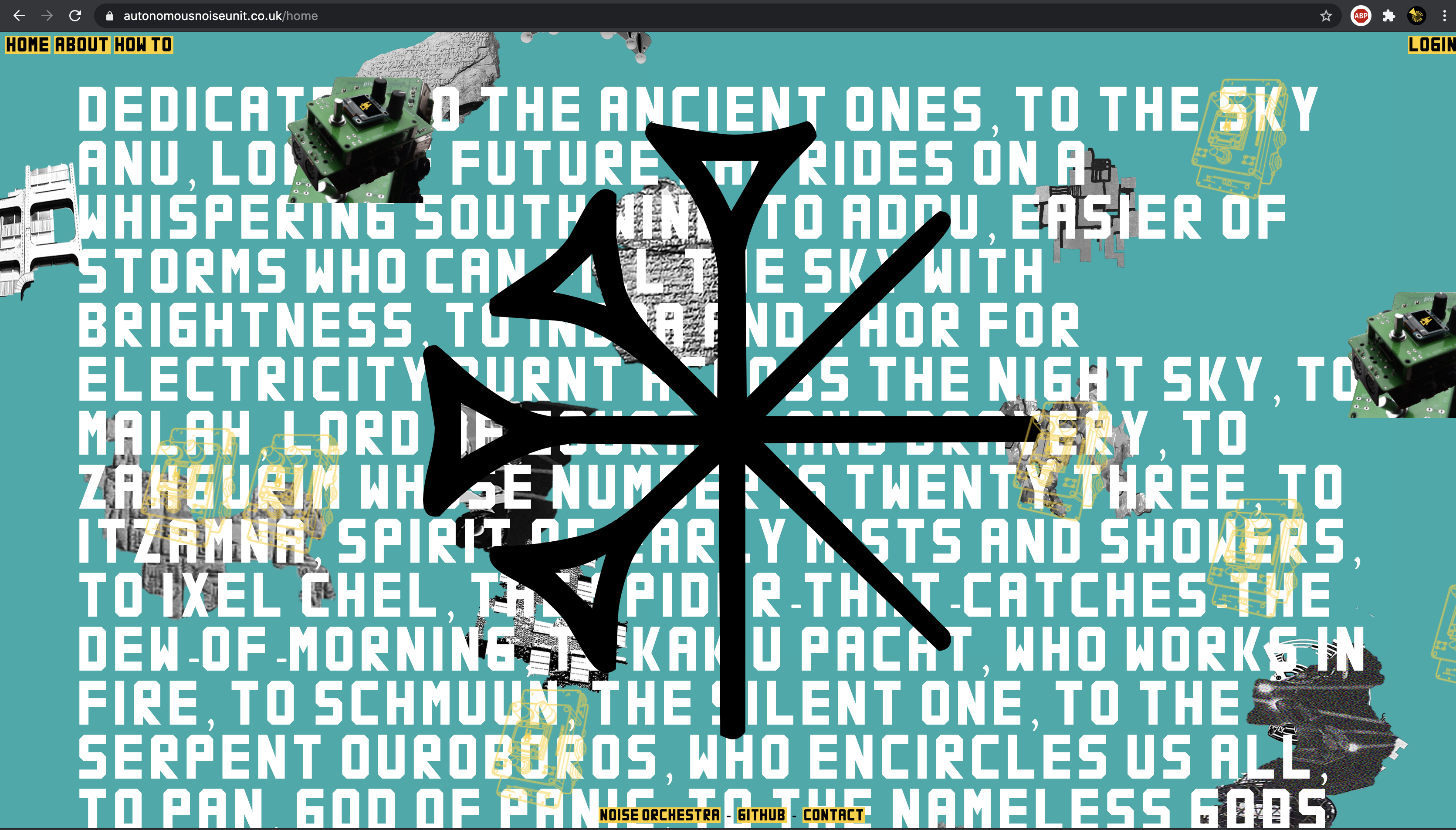
I worked on the visual design for the project, ANU – god of the skies! We wanted to communicate ideas of transmission, summoning up ancient ritual noise fragments and communing with others across the network, Dave created a fantastic narrative for the piece (*remember to click on the ANU logo) and read the scroll.
ANU god of the skies narrative
The website platform provides an introduction to the project, a technical ‘how to’ guide and signal flow approach plus frequently asked questions. Importantly musicians can create their own login profile and the server automatically saves the audio file of the recorded sessions for archive and playback. The platform represents the first phase in development, Dave and Sam are continuing live jam tests across the UK, Europe and further afield, it’s been fascinating to test these geographical potentials. The internet as a space for improvisation is fertile ground for experimentation, bringing into question how we collaborate, perceive and communicate within this dimension and what that means for the players and the listeners within networked time based media. We intend to progress the project with more groups and testing and further technical developments including hosting a listen back page on the website, where previous jams can be livestreamed and played back.
Visit the ANU website to learn more about the project, or our Noise Orchestra Blog to read about the technical development stages. It was a brilliant collaborative project bringing wonderful Sam Andreae into the Noise Orchestra fold who did an amazing job coding the hardware and website. We also worked with Tom Ward on the Noise Server and as ever legend Chris Ball who made the dashing laser cut boxes for the test modules.
signal flow diagram
We’re enjoying the feedback from musicians and groups who have been using the ANU units, we’ll keep you posted on next stages.
I was invited to present my work at ‘Creative Explorations: From Social Entities to Ubiquitous Systems: ‘How digital is changing the way we relate to each other’ conference in Sept 2020. Sharing my perspective on DIY music technologies, through creation and participation and how this aids cultural and human connection. The conference took place during the second UK lockdown and was an interesting point in time to reflect on the role of technology, relationships and communication. I was thrilled to part of such a stellar lineup of speakers who I admire, including legend Robert Henke!
Connect for Creativity is an EU funded, 18-month project led by the British Council, in collaboration with ATÖLYE and Abdullah Gül University in Turkey, Bios in Greece and Nova Iskra in Serbia.
SLEEPSTATES EXHIBITED IN DISTANT ARCADES | MUTEK MONTREAL
As part of AmplifyDAI we were invited to present our work within the context of MUTEK Montreal’s Hybrid online exhibition. My sound piece SleepStates featured within Distant Arcades, the festival’s virtual exhibition.
About the piece
SleepStates is a sound work exploring machine addiction, sleep territories and sonic algorithmic control. Utilising sound sculpture, DIY electronics, broken radio transmissions and an AI trained on lucid dreams, self help slumber fragments and cyber-socialist manifestos.The piece is part of my ongoing SLEEP_STATESDOTNET project, a browser based artwork where the user sleepwalks between different states or audiovisual moments of anxiety, inertia and online perpetuity. I collaborated with digital artist Izzy Bolt who created the video piece working with TouchDesigner.
About Distant Arcades
“Distant Arcades is interested in how artists are convening and creating using distance and technology. It features sound works, videos, 360s, and virtual-reality, echoing the tools and concepts discussed during MUTEK Forum: technology and the city, algorithmic bias, collection of personal data, technological racism, and the links between technology, machines and human emotions.”
Turn it Up
In TURN IT UP, we presented our work online to MUTEK audiences, these artist talks were a chance to connect with Mutek’s global community of artists, technologists and curators.
This opportunity was part of AmplifyDAI the digital artist development programme I am on 2020-2021 support women in UK, Argentina and Canada. Great to join the MUTEK community and looking forward to future collaborations.
I’m happy to announce i’ve been selected for the Amplify Digital Artist Initiative 2020 cohort by British Council, Somerset House Studios and MUTEK, joining 20+ artists from Argentina, Canada, and the UK. This artist development and collaborative programme will support me over the next year as I develop my work and our cohort will join a series of public-facing discursive, exhibition and performance activities during MUTEK Montreal’s up and coming festival’s hybrid festival edition running this September 8 – 13.
Amplify Digital Arts Initiative connects and empowers an active network of women-identifying artists and professionals working in the digital arts, sound and immersive storytelling sectors in Canada, Latin America and the UK. Harnessing different cultures and experiences, AMPLIFY D.A.I fosters a platform for dialogue on gender equity and commits resources to career and capacity building activities, peer exchanges and opportunities for cohort participants to showcase their work in the context of dynamic, contemporary festivals, events and residencies. You can read more about the programme and amazing artists, i’m so excited to be involved and learn from being part of this community.
AMPLIFY D.A.I is an initiative of the British Council in partnership with MUTEK Montréal, MUTEK Buenos Aires and Somerset House Studios in the UK. The programme is supported by Canada Council for the Arts and Fundación Williams.








 VICKY CLARKE